
EPO-TEK® UV Epoxy for Micro Molded Lens in Camera Module, ADAS & LiDAR
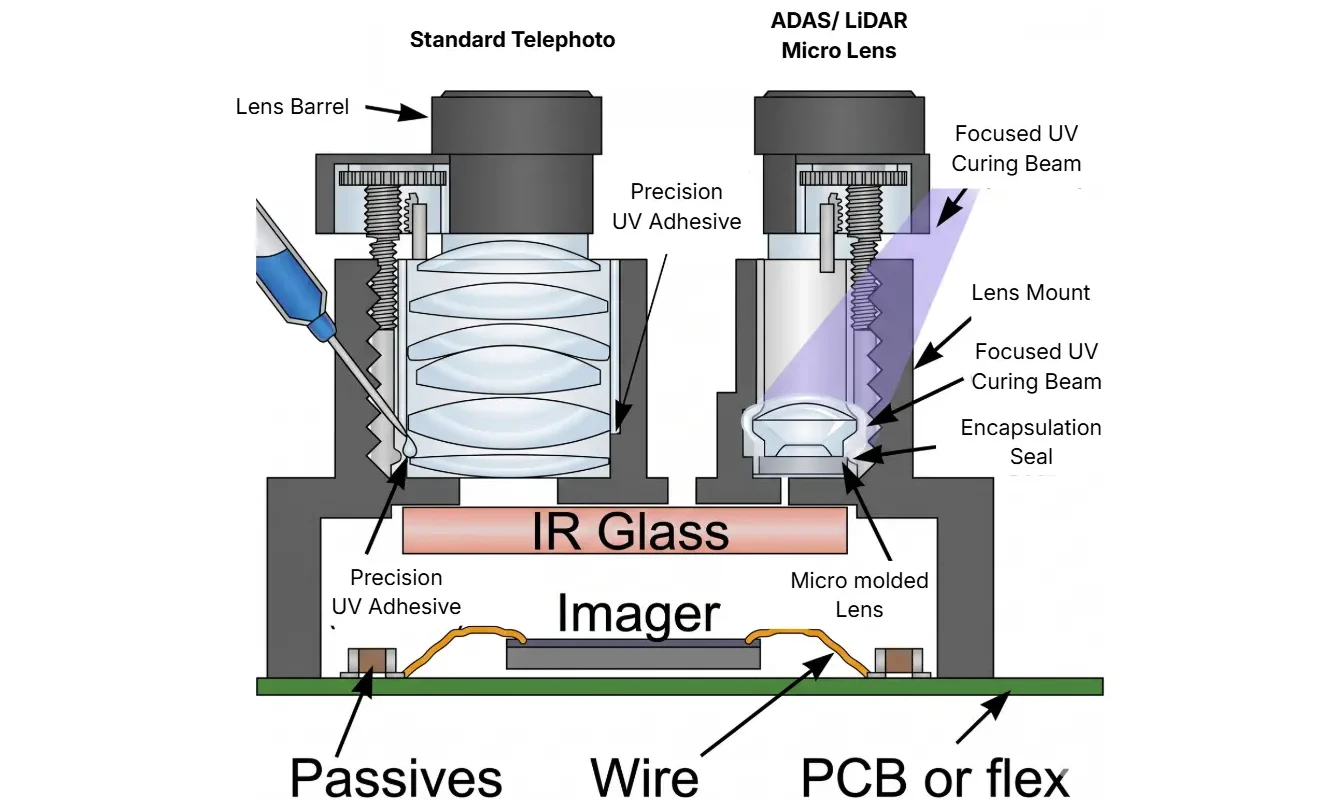
In camera modules for ADAS (Advanced Driver Assistance Systems) and LiDAR systems, the micro molded lens sits at the very top of the optical stack — Position ① in the module assembly. It is a precision-formed miniature lens, typically made from optical-grade plastic or glass, that focuses incoming light onto the image sensor below.
Why the Adhesive Is a Critical Optical Component
The epoxy used at this stage is not merely structural — it is part of the optical path. Any absorption, scattering, or refractive index mismatch directly reduces image quality, object detection range, and sensor sensitivity across visible and NIR wavelengths.
EPO-TEK® offers two UV-curable epoxies purpose-engineered for this application: OG142-112-LH (low-halogen, optical sealing & encapsulation) and OG198-54 (shadow cure, active alignment).
What the Adhesive Must Deliver at This Position
Micro molded lens bonding in automotive modules imposes five simultaneous requirements — each of which becomes more stringent with every generation of ADAS sensor resolution and LiDAR range increase.
Ultra-High Optical Transparency
Any absorption or scattering in visible and NIR spectrum directly reduces image quality, object detection range, and sensor sensitivity at 850 nm, 905 nm, and 1,550 nm
Precise Refractive Index
Published RI values at multiple wavelengths allow optical engineers to model the adhesive layer accurately in lens stack calculations and MTF analysis
Dimensional Stability After Cure
Lens position is fixed at micron-level precision — the adhesive must resist creep, thermal relaxation, and moisture-induced movement over the vehicle’s lifetime
Rapid UV Cure for High-Volume Production
Automotive camera modules are manufactured at massive scale — fast UV-curable adhesives enable inline process speeds that thermal-cure systems cannot match
Automotive Thermal Reliability
Must survive thousands of thermal cycles from -40°C to +125°C, road vibration, and long-term humidity exposure across 10+ years of field service
Recommended EPO-TEK® Products for Micro Molded Lens
Two single-component UV epoxies — no mixing, no pot life, no mix-ratio errors — engineered for the specific optical and process demands of ADAS camera and LiDAR module assembly.
Low-halogen, single-component UV epoxy for optical sealing and encapsulation. Tg ≥129°C, published RI at 589/830/1550 nm, 1-year refrigerated shelf life. RoHS/REACH compliant.
Tg ≥129°C
RI at 3 wavelengths
1 year shelf life
Shadow-curable UV epoxy for active alignment. Cures in lens shadow areas where UV cannot reach directly. Lowest viscosity (200–450 cPs), highest transmission (≥97%), 30-second cure.
≥97% transmission
200–450 cPs
30-sec cure
EPO-TEK® OG142-112-LH — Technical Specifications
Low-halogen UV epoxy for optical sealing and encapsulation. The compliance-safe choice for automotive supply chains with published refractive index at 587 nm, 830 nm, and 1,550 nm — enabling precise optical system modeling.
EPO-TEK® OG142-112-LH — Full Technical Data
| Property | Value | Note |
|---|---|---|
| Components | Single-component | No mixing — no pot life concerns |
| Specific Gravity | 1.19 | |
| Color (uncured) | Clear / Colorless | Pourable liquid |
| Viscosity @ 23°C (100 rpm) | 800–2,000 cPs | |
| Recommended Cure | Iron-doped mercury flood lamp >90 sec @ 100 mW/cm² (240–365 nm) | Alt: 365nm LED >4 min; pulsed mercury >2.5 min |
| Glass Transition (Tg) | ≥ 129°C | Highest Tg of the two products |
| Shore D Hardness | 83 | |
| CTE below Tg | 55 × 10⁻⁶ in/in°C | |
| CTE above Tg | 158 × 10⁻⁶ in/in°C | |
| Die Shear (UV cure) | 22 Kg (7,832 psi) | |
| Die Shear (UV + 120°C/1 hr) | 23.9 Kg (8,499 psi) | Post-cure strengthens bond further |
| Degradation Temperature | 406°C | Highest of the two products |
| Operating Temp | < 300°C | Intermittent |
| Spectral Transmission @ 23°C | ≥ 96% @ 460–1,620 nm | Covers full ADAS (850 nm) and LiDAR (905 nm, 1,550 nm) range |
| Refractive Index (uncured) | 1.5374 @ 589 nm | |
| Refractive Index (cured) | 1.5629 @ 587 nm · 1.5523 @ 830 nm · 1.5446 @ 1,550 nm | Published at 3 wavelengths — enables full optical system modeling |
| Shelf Life | 1 year refrigerated | Bulk and syringe |
| Halogen Content | Low halogen | RoHS / REACH compliant automotive supply chain |
Key Performance Advantages
Low Halogen — RoHS & REACH Compliant
Meets automotive supply chain environmental compliance requirements without compromising optical performance — the low-halogen version of OG142-112
Multi-Wavelength RI Data
Published RI at 587 nm (visible), 830 nm (NIR camera), and 1,550 nm (long-wave LiDAR) — enables accurate optical modeling in lens stack design and MTF analysis
Tg ≥129°C for Automotive Stability
Highest Tg of the two products — maintains dimensional stability and lens position across -40°C to +125°C automotive qualification temperature range
Single-Component Automation
No mixing, no mix-ratio errors, no pot life management — simplifies automated dispensing and improves process yield in high-volume automotive camera production
EPO-TEK® OG198-54 — Technical Specifications
Shadow-curable UV epoxy for active alignment of micro lenses. The lowest viscosity product in the family — enables finest bead placement around micro-scale elements while shadow cure ensures complete bonding even where UV cannot reach directly.
EPO-TEK® OG198-54 — Full Technical Data
| Property | Value | Note |
|---|---|---|
| Components | Single-component | No mixing — no pot life concerns |
| Specific Gravity | 1.12 | |
| Color (uncured) | Clear / Colorless | Pourable liquid |
| Viscosity @ 23°C (100 rpm) | 200–450 cPs | Lowest viscosity — finest dispensing tip, maximum wicking |
| Recommended Cure | Iron-doped mercury flood lamp >30 sec @ 100 mW/cm² (240–365 nm) | 3× faster than OG142-112-LH |
| Shadow Cure | Yes — cure propagates beyond UV zone | Essential for bonding beneath lens body |
| Glass Transition (Tg) | ≥ 115°C | |
| Shore D Hardness | 86 | Higher than OG142-112-LH (83) — more rigid post-cure |
| CTE below Tg | 74 × 10⁻⁶ in/in°C | |
| CTE above Tg | 145 × 10⁻⁶ in/in°C | |
| Die Shear (UV only) | ≥ 10 Kg (3,556 psi) | Immediate alignment lock |
| Die Shear (UV + 23°C/24 hrs) | 20.8 Kg (7,397 psi) | Room temp post-cure option |
| Die Shear (UV + 80°C/1 hr) | 22.2 Kg (7,894 psi) | ~2.2× improvement over UV-only |
| Degradation Temperature | 369°C | |
| Operating Temp | < 300°C | Intermittent |
| Spectral Transmission | ≥ 97% @ 460–1,680 nm | Highest transmission of the two products |
| Refractive Index (uncured) | 1.5046 @ 589 nm | |
| Refractive Index (cured) | 1.5256 @ 589 nm | Lower RI than OG142-112-LH — model both during design phase |
| Shelf Life | 6 months refrigerated |
Shadow Cure — Why It Matters for Lens Bonding: In micro lens assembly, the lens body itself blocks UV light from reaching the adhesive bead around its full perimeter. OG198-54’s iron-doped photoinitiator chemistry continues propagating cure into shaded zones after initial UV exposure — ensuring a complete, void-free bond around the entire lens base, not just the UV-accessible portion.
Key Performance Advantages
Shadow Cure — Critical for Lens Geometry
Cure propagates into areas UV cannot reach directly — the lens body itself creates shadow zones that would leave conventional UV adhesives partially uncured
≥97% Transmission — Highest of the Two
Critical for high-resolution ADAS front cameras and long-range LiDAR receivers where even fractional optical losses directly affect detection performance
200–450 cPs — Finest Bead Placement
Lowest viscosity enables the finest dispensing tip sizes and most precise adhesive bead placement around micro-scale lens elements for sub-micron active alignment
30-Second Cure — Fastest Active Alignment Lock
3× faster than OG142-112-LH — freezes the aligned lens position immediately after peak signal detection, before thermal or mechanical drift can occur
OG142-112-LH vs OG198-54 — Complete Comparison
Both are single-component UV epoxies for the same lens bonding application — the decision comes down to whether low-halogen compliance and sealing performance, or shadow cure and fastest alignment, is the primary process requirement.
| Parameter | OG142-112-LH | OG198-54 |
|---|---|---|
| Components | Single | Single |
| Viscosity | 800–2,000 cPs | 200–450 cPs Lower — finer dispense |
| Glass Transition (Tg) | ≥ 129°C Higher | ≥ 115°C |
| Shore D Hardness | 83 | 86 More rigid |
| Spectral Transmission | ≥ 96% @ 460–1,620 nm | ≥ 97% @ 460–1,680 nm Higher + wider |
| Shadow Cure | ❌ No | ✅ Yes Lens shadow areas |
| Low Halogen | ✅ Yes RoHS/REACH | — |
| Cure time (flood lamp) | > 90 sec | > 30 sec 3× faster |
| Refractive Index (cured @ 589 nm) | 1.5629 Higher RI | 1.5256 |
| RI at NIR wavelengths | 1.5523 @ 830 nm; 1.5446 @ 1,550 nm | Not published |
| Die shear (UV + post-cure) | 23.9 Kg @ UV + 120°C/1hr | 22.2 Kg @ UV + 80°C/1hr |
| Degradation temp | 406°C Higher stability | 369°C |
| Shelf life | 1 year refrigerated Longer | 6 months refrigerated |
| Best for | Optical sealing, encapsulation, low-halogen compliance | Active alignment, shadow-area bonding, fastest cycle time |
Why UV Epoxy — and Why EPO-TEK® — for Micro Lens Bonding
UV-cure epoxy offers decisive process advantages over thermal-cure for micro lens bonding in automotive camera modules — and EPO-TEK® UV epoxies are specifically engineered to meet automotive imaging wavelength and reliability requirements.
Engineered for Automotive Wavelengths
>96% transmission across 400–900 nm (ADAS cameras) and at 905 nm / 1,550 nm (LiDAR). RI values at multiple NIR wavelengths support accurate lens stack optical modeling
Active Alignment Compatible
Both products cure fast enough to freeze the calibrated lens position before drift occurs — UV-cured alignment lock at peak signal quality, not during a slow thermal ramp
Automotive Reliability Over Vehicle Lifetime
Tg ≥115–129°C, die shear >7,000 psi post-cure, and low weight loss at elevated temperatures — qualified for 10+ years of -40°C to +125°C field service
UV vs Thermal: Decisive Advantages
On-demand cure in seconds enables high-throughput inline production. No heat during cure protects plastic lens materials from thermal distortion. Single-component simplifies dispensing automation
Broad Substrate Compatibility
Bonds reliably to polycarbonate, COC/COP, PMMA, glass, metal lens holders, and PCB substrates — covers the full range of micro molded lens materials in automotive module designs
Frequently Asked Questions
EPO-TEK® OG142-112-LH and OG198-54 are both recommended. OG142-112-LH is preferred for optical sealing and encapsulation with low-halogen supply chain compliance. OG198-54 is preferred for active alignment workflows and assemblies where the lens geometry or module housing creates shadow areas that block direct UV exposure to part of the adhesive bead.
Shadow cure refers to an epoxy’s ability to complete curing in regions that UV light cannot directly illuminate — areas beneath or behind the lens element. OG198-54 propagates the cure reaction into shaded zones after the initial UV exposure using iron-doped photoinitiator chemistry. This is critical because the lens body itself blocks UV from reaching the entire adhesive bead — an uncured region would create a structural weak point that could allow lens movement under thermal cycling or vibration.
After cure: 1.5629 at 587 nm (visible), 1.5523 at 830 nm (NIR camera), and 1.5446 at 1,550 nm (long-wave LiDAR). These multi-wavelength values are published to enable accurate optical modeling of the adhesive layer in lens stack design and MTF analysis — a critical capability for precision ADAS and LiDAR optical design.
Yes. Both OG142-112-LH (≥96% transmission at 460–1,620 nm) and OG198-54 (≥97% at 460–1,680 nm) maintain high transparency at 905 nm and 1,550 nm — the two dominant LiDAR wavelengths. OG142-112-LH additionally provides published refractive index at 830 nm and 1,550 nm for accurate LiDAR optical path modeling.
Both products require UV light sources at 240–365 nm. Compatible equipment includes iron-doped mercury flood lamps (most common), 365 nm LED flood lamps, and pulsed mercury lamps. OG142-112-LH: >90 seconds at 100 mW/cm². OG198-54: >30 seconds at 100 mW/cm² — 3× faster cycle time.
OG142-112-LH has a higher RI (1.5629 cured at 587 nm) compared to OG198-54 (1.5256 cured at 589 nm). This difference influences the optical path length calculation in the lens stack. Optical engineers should model both products during the design phase to select the one best matched to their system RI requirements at each operating wavelength.
Yes. EPO-TEK® UV epoxies are widely used for bonding optical-grade plastics including polycarbonate, cyclic olefin copolymer (COC/COP), and PMMA — in addition to glass and metal lens holders. This covers the full range of micro molded lens materials used in automotive camera module designs.
UV-cure offers four decisive advantages for micro lens bonding: (1) on-demand cure in seconds enables high-throughput inline production; (2) cure is triggered precisely when the lens is in its aligned position — eliminating drift during a slow thermal ramp; (3) no heat during cure protects plastic lens materials (PC, COC, PMMA) from thermal distortion; (4) single-component systems eliminate mix-ratio errors and simplify dispensing automation at automotive production scale.