Pre-Cured vs. Curing-Type Gap Filler: Which Process Fits Your Production Line?
Both types deliver effective thermal interfaces. The decision between them is not about thermal performance — it’s about your production process, your equipment footprint, and your total cost of ownership.
The Key Insight Most Engineers Miss
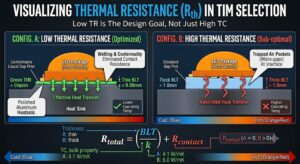
At equivalent bondline thickness, pre-cured and 2-part curing gap fillers deliver equivalent thermal performance. The decision is entirely about process fit — equipment investment, failure modes you need to eliminate, production volume, and total cost of ownership including yield loss and capital.
What Each Type Actually Is
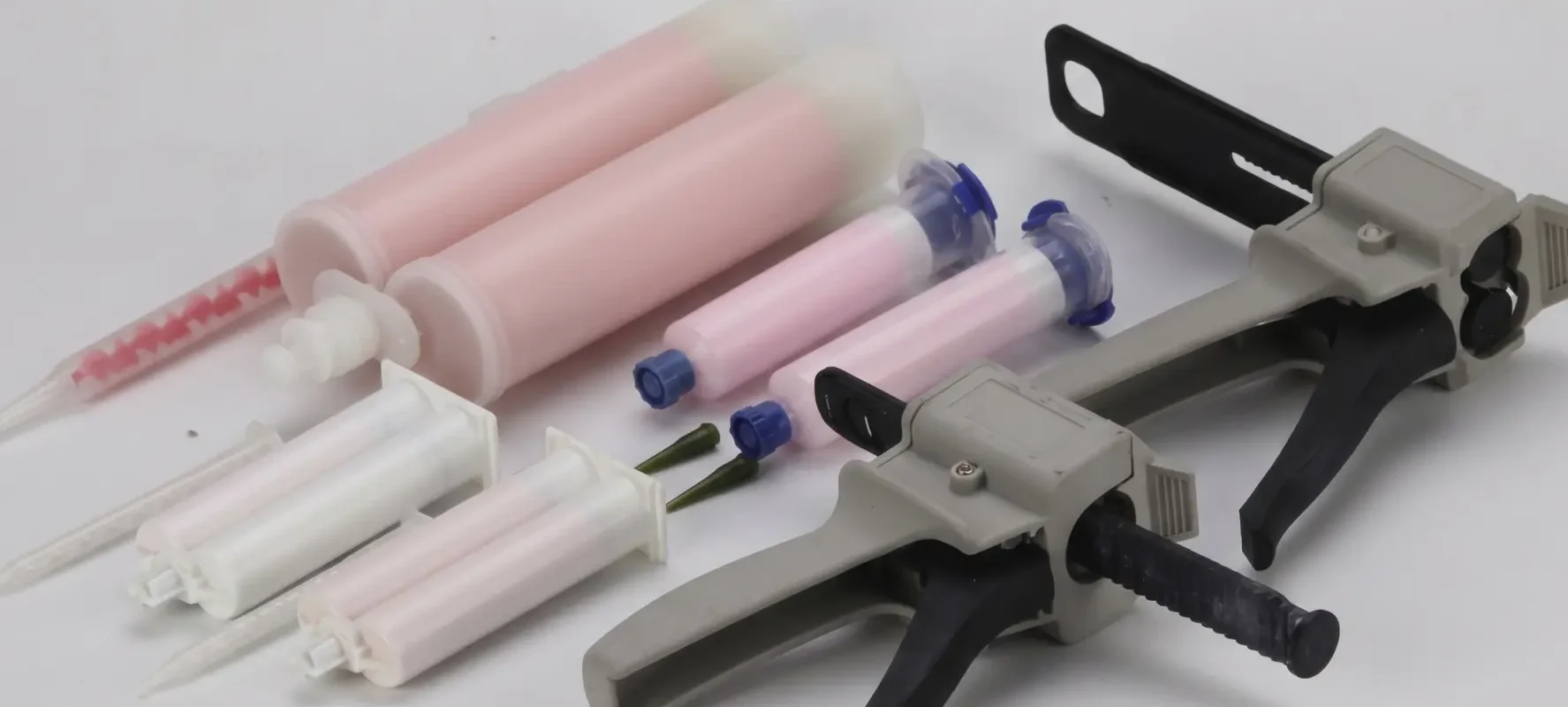
Before comparing, it helps to be precise. Three distinct formats exist — each with a different process requirement and failure mode profile.
2-Part Curing Gap Filler
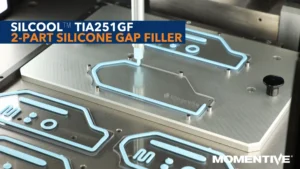
Two components (A+B) mixed at dispense and cured in place — at room temperature or with heat. Requires a meter-mix dispenser and a cure step. Examples: TIA241GF (4.1 W/mK), TIA251GF (5.1 W/mK), TIA2101GF (10.1 W/mK)
1-Part Pre-Cured Gel
Arrives from the factory already cured as a soft gel. Applied by dispensing directly — no mixing, no cure step, no waiting. Examples: TIA141GF (4.1 W/mK), TIA165GF (6.2 W/mK), TIA1123GF (12.3 W/mK)
1-Part Curing-Type
Single component, cure initiated by heat. Simpler than 2-part but still requires a cure step. Storage typically requires refrigeration at ≤5°C — a logistics constraint the pre-cured format eliminates
2-Part Curing vs. 1-Part Pre-Cured — Process Comparison
| Criteria | 2-Part Curing | 1-Part Pre-Cured |
|---|---|---|
| Equipment complexity | High — meter-mix dispenser required | Low — single-component dispenser Simpler |
| Mixing required | Yes — static mixer, ratio control critical | No Zero mixing risk |
| Cure step required | Yes — 30 min @ 70°C or 24h @ 23°C | No Ready to use |
| Assembly time window | 1–3 hours (pot life limit) | No limit Unlimited |
| Storage condition | Room temperature | Room temperature Same |
| Oil separation risk | Moderate — lower viscosity grades | Low — already cured Lower risk |
| Cure failure risk | Exists — mixing ratio, contamination | None — already cured Eliminated |
| Pump-out resistance | Good after full cure | Good — no cure phase |
| Thermal conductivity range | 2.4–15.0 W/mK (current lineup) Widest range | 4.1–15.7 W/mK |
| Reworkable | ✅ Yes | ✅ Yes |
| Cost per gram (material) | Lower Material cost | Higher — factory cure included |
| Total cost of ownership | Higher at low volume — capital + yield loss | May be lower at <500 units/day TCO at low volume |
When 2-Part Curing Is the Right Choice
2-part curing systems have clear advantages in the right production context. If all four of these conditions apply to your situation, 2-part is likely the better fit.
When Pre-Cured Is the Right Choice
Pre-cured gap filler eliminates entire categories of process failure modes. If any of these conditions describe your situation, pre-cured is likely the lower-risk, lower-TCO path.
EMS / Mixed-Product Facilities
Production line cannot accommodate a ratio-control dispensing system — common in EMS environments or facilities running mixed products where dedicated meter-mix equipment is not justified
Eliminate Cure-Related Failure Modes
No mixing means no mix-ratio error, no static mixer degradation, no catalyst inhibition risk — entire categories of in-process yield loss are structurally impossible
Long Dispense-to-Closure Window
Assembly sequence requires extended time between dispense and closure — pre-cured material can sit indefinitely without concern for pot life or gelation in the dispenser
R&D and Prototyping
A pre-cured syringe is ready to use immediately — no process qualification, no meter-mix setup, no pot life management. Significantly reduces time-to-first-sample
Eliminate Refrigeration Logistics
Pre-cured grades are room-temperature stable — unlike 1-part curing-type grades which require ≤5°C storage. Eliminates cold chain logistics and storage constraints from your supply chain
Low-to-Medium Volume Production
Under ~500 units/day, total cost of ownership for pre-cured may be lower than 2-part even with higher material cost per gram — once capital, maintenance, and yield loss are included
The Total Cost Comparison Most Engineers Overlook
The per-gram material cost of pre-cured gap filler is higher. But material cost is only one line item in the real cost comparison. Run this full calculation before defaulting to 2-part on material cost grounds alone.
| Cost Component | 2-Part Curing | 1-Part Pre-Cured |
|---|---|---|
| Material cost per gram | Lower Cheaper | Higher — factory cure included in price |
| Meter-mix dispenser capital | Required — significant capital cost | Not required Zero |
| Mixer replacement + calibration labor | Ongoing — every shift or N cartridges | None Zero |
| Yield loss from cure failures | Exists — mix ratio, contamination, pot life | None — no cure process Zero |
| Oven equipment + energy (heat cure) | Required unless room-temp cure acceptable | Not required Zero |
| Operator training for ratio control | Required + SPC for ongoing monitoring | Minimal Lower |
| Refrigeration / cold chain logistics | None needed (RT stable) | None needed (RT stable) Same |
| TCO break-even volume (approx.) | Favorable above ~500 units/day | May be lower TCO below ~500 units/day Low volume |
How to run the calculation: Estimate annual capital amortization of dispensing equipment + annual mixer replacement cost + annual yield loss rate × unit value + oven energy cost. Compare this overhead to the material cost premium of pre-cured at your annual volume. For most low-to-medium volume production environments, the break-even point is lower than engineers expect before running the numbers.
Available Grades — 2-Part Curing vs. Pre-Cured
Both format families cover the thermal conductivity range from standard to ultra-high performance. Select TC grade based on your thermal model — then select format based on your process analysis.
2-Part Curing Grades
| Product | Thermal Conductivity | Best Fit Application |
|---|---|---|
| TIA241GF | 4.1 W/mK | Standard EV battery modules, telecom PCB-to-chassis, general electronics |
| TIA251GF | 5.1 W/mK | Mid-range power density applications |
| TIA2101GF | 10.1 W/mK | High power density — EV battery AAU, 5G high-density RU, OBC |
1-Part Pre-Cured Grades
| Product | Thermal Conductivity | Best Fit Application |
|---|---|---|
| TIA141GF | 4.1 W/mK | Drop-in equivalent to TIA241GF — same TC, pre-cured process |
| TIA165GF | 6.2 W/mK | Mid-high performance, process-simplicity priority |
| TIA1123GF | 12.3 W/mK | Ultra-high TC in pre-cured format — EMS lines, R&D, complex assemblies |
Frequently Asked Questions
Pre-cured gap filler arrives from the factory already cured as a soft silicone gel — dispensed directly onto the substrate with no mixing, no cure step, and no waiting. Curing-type gap filler (2-part A+B) is mixed at dispense and cures in place at room temperature or with heat, requiring a meter-mix dispenser and a cure cycle. Both deliver equivalent thermal performance at equivalent bond line thickness — the difference is entirely process-related.
Pre-cured has higher material cost per gram — factory cure is included. But total cost of ownership for 2-part includes: capital cost of meter-mix dispensing equipment, mixer replacement and calibration labor, yield loss from cure failures and mix-ratio errors, oven equipment and energy, and operator training for ratio control. For production below ~500 units/day, total TCO for pre-cured may be lower despite higher material cost — run the numbers for your specific volume before defaulting to 2-part on cost grounds.
Yes, in most cases. Pre-cured grades match the TC of 2-part grades — TIA141GF at 4.1 W/mK is the pre-cured equivalent of TIA241GF at 4.1 W/mK. At equivalent BLT, both deliver equivalent thermal resistance. The process change requires switching to a single-component dispenser and eliminating the cure step — which also eliminates mix-ratio verification, static mixer management, and cure cycle from the production process.
No. Pre-cured gap filler has no pot life — it is already fully cured and cannot further crosslink during production. Material can sit in the dispenser between cycles without concern for gelation, and assembled parts can wait indefinitely between dispense and closure. This eliminates one of the most common process control requirements for 2-part systems.
Switching to pre-cured eliminates: mix-ratio errors from meter-mix equipment drift; static mixer degradation causing incomplete mixing; catalyst inhibition from substrate contamination; cure failures from oven temperature variation; oil separation and crosslinking in the dispenser during idle time; and pot life exceedance during line pauses. These are the primary sources of yield loss in 2-part gap filler production processes.
No. Pre-cured grades are room-temperature stable — no cold chain logistics required. This is a significant advantage over 1-part curing-type gap fillers, which typically require storage at ≤5°C. Room-temperature stability simplifies warehousing, reduces logistics cost, and eliminates cold-start viscosity variation at the dispenser when material is brought from storage to production.
The Decision in One Sentence Each
Pre-cured: if process simplicity, reliability, and eliminating cure-related failure modes matter more than material cost per gram — or if you’re below ~500 units/day. 2-part curing: if you have existing 2-part infrastructure, high production volume, or need grades above 10 W/mK where 2-part currently has more options. Both deliver equivalent thermal performance at equivalent BLT.
Not Sure Which Format Fits Your Production Line?
Our technical team can help you evaluate process fit, run a total cost of ownership comparison for your production volume, and identify the right grade — pre-cured or 2-part — for your application.