Vertical Stability Failure: Why Your Gap Filler Slides Down After Assembly — and How to Stop It
You dispense, assemble, and send the board through thermal cycling. When you check the joint, the gap filler has migrated downward — leaving the top of the interface dry and the bottom pooled. This is a vertical stability failure, and it’s more common than most engineers expect.
The Core Problem: Lab Data vs. Real-World Orientation
Most thermal interface material data is collected on horizontal test fixtures. But real-world electronics — telecom base station cards, automotive inverters, EV battery modules — are often mounted vertically or at angles, where gravity acts on the gap filler continuously.
Why Vertical Stability Matters in Real Designs
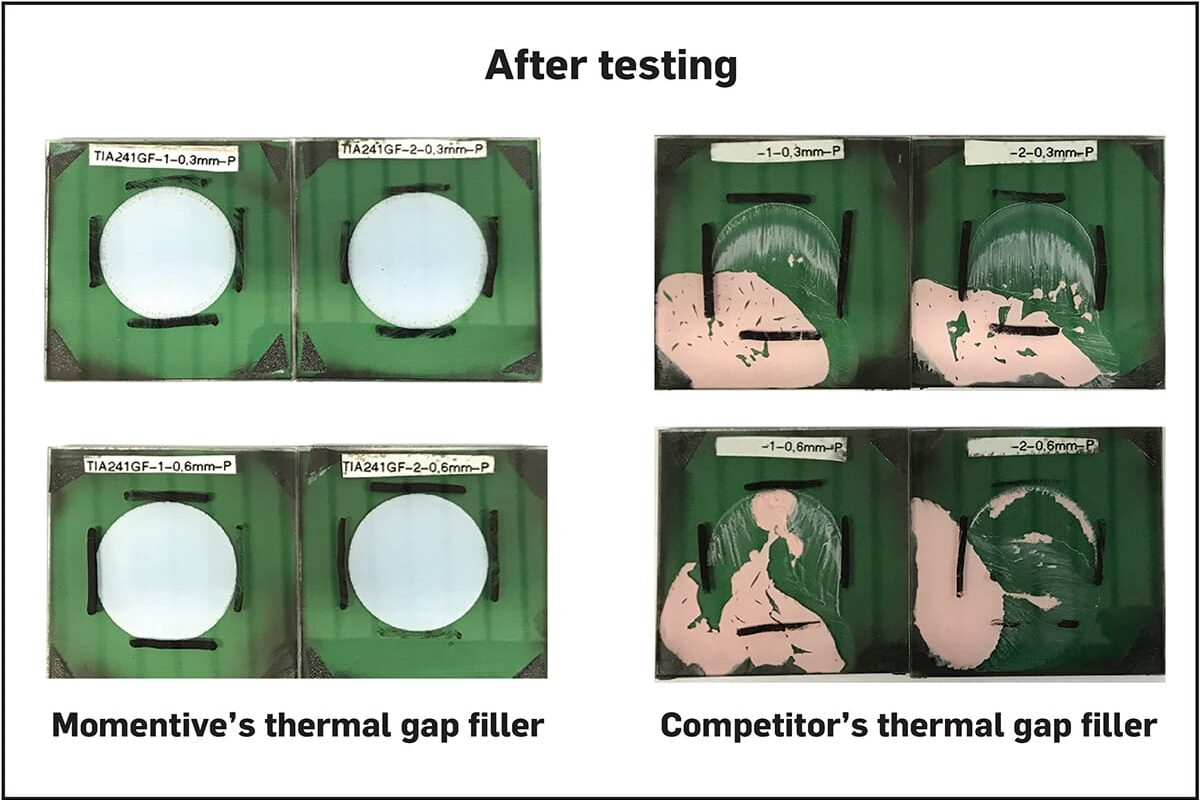
A material that passes BLT and thermal resistance specifications on a flat test coupon may fail completely in a vertical-mount application if it lacks adequate thixotropic structure to resist flow after cure.
Telecom Base Station Cards
Blade servers and line cards mount vertically in racks — gap filler at component interfaces is under constant gravitational load throughout the product lifetime
Automotive Inverters
Power inverters in EV drivetrains operate in orientations determined by packaging constraints — not by material test standards. Migration during thermal cycling creates hot spots
EV Battery Module Assemblies
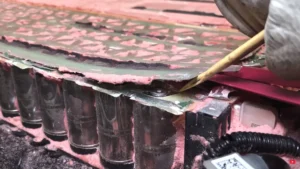
Prismatic and pouch cell modules use gap filler between cells in vertical stacks — uniform thermal contact across the entire interface is critical for cell balancing
Thermal Cycling Makes It Worse
During thermal cycling, gap filler softens and hardens repeatedly. Each hot cycle allows additional migration. Over hundreds of cycles, a small initial tendency to flow becomes a complete interface failure
Three Failure Scenarios — and the Fix for Each
Vertical stability failure has three distinct mechanisms. Identifying which scenario applies to your situation determines the correct corrective action — applying the wrong fix will not solve the problem.
Scenario A — Migration Before Cure Completes
Root cause: pre-cure viscosity and thixotropy. 2-part systems have a pot life window during which the material is still fluid and susceptible to flow under gravity. Assembling and leaving vertical for extended time before oven cure creates a migration window that cannot be closed without process changes.
Example: A grade with pot life of ~2 hours at room temperature — assembling, then leaving the assembly vertical for several hours before oven cure — gives gravity a significant window to act on uncured material.
Fixes for Scenario A:
Minimize Dispense-to-Cure Window
Reduce the time between dispense and cure start — the smaller this window, the less migration opportunity before the material develops structural integrity
Horizontal Hold if Delay is Required
If your process requires a hold period before oven cure, orient the assembly horizontally during that window — gravity acts perpendicular to the interface rather than along it
Consider Shorter Pot Life Grade
A grade with shorter pot life and faster green strength development reduces the migration window — at the cost of a tighter process time budget
Scenario B — Creep During Thermal Cycling
Root cause: insufficient post-cure modulus at operating temperature. Cured gap fillers are elastomers — not rigid solids. They have a finite modulus and will creep under sustained gravitational load, especially when the material softens at elevated temperature. A low-hardness grade running frequent cycles to 85–100°C may migrate slowly but continuously over hundreds of cycles.
Critical error to avoid: Checking hardness and modulus data only at room temperature. A grade that feels adequately rigid at 25°C may soften significantly at 85°C or 100°C — the actual operating temperature where creep occurs. Always verify material properties at the thermal cycling peak temperature.
Fix for Scenario B:
Check Properties at Operating Temperature
Verify hardness and modulus data for your grade at peak cycling temperature — not just at 23°C room temperature. Many TDS documents only report room-temperature values; request elevated-temperature data from your supplier
Specify a Higher-Hardness Grade
For high-cycling applications, a higher Type E hardness grade resists creep better at elevated temperatures — at the cost of higher mechanical stress transmitted to components. Evaluate the stress trade-off for your specific assembly
Scenario C — Pump-Out During Thermal Cycling
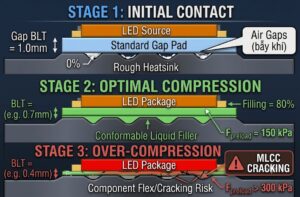
Root cause: cyclical expulsion driven by assembly mechanics. Pump-out is distinct from simple downward migration — it is a progressive expulsion of gap filler from the bondline over repeated thermal cycles, driven by cyclical compression and expansion of the assembly stack. More pronounced where heatsink clamp force is inconsistent or where there is significant CTE mismatch between components.
Verify Consistent Clamp Pressure
Confirm the assembly maintains consistent clamp pressure across the full temperature range. Inconsistent pressure creates a pumping action that progressively displaces the gap filler from high-pressure to low-pressure zones
Specify Pump-Out Resistance Data
Look for pump-out resistance data in the product TDS — this is a specific reliability qualification test. Products with this data have been validated for vertical and pump-out scenarios. Do not assume all grades have equivalent pump-out resistance
Three Scenarios — Diagnostic Summary
| Dimension | Scenario A — Pre-Cure Migration | Scenario B — Thermal Creep | Scenario C — Pump-Out |
|---|---|---|---|
| When it occurs | During assembly-to-cure hold period | Over many thermal cycles at elevated temp | Progressively over repeated cycles |
| Root cause | Insufficient pre-cure thixotropy; long pot life window in vertical orientation | Low cured modulus / hardness at operating temperature | Inconsistent clamp force; CTE mismatch driving cyclic expulsion |
| Visual pattern | Material pooled at bottom immediately after first cure | Gradual migration observed only after many cycles | Material expelled from bondline edges — not directional |
| Primary fix | Minimize dispense-to-cure time; horizontal hold if delay required | Specify higher-hardness grade; verify modulus at peak cycling temperature | Verify consistent clamp pressure; specify grade with pump-out data |
| Key spec to check | Pot life vs. assembly-to-cure window | Hardness / modulus at operating temperature — not just 23°C | Vertical stability and pump-out resistance data in TDS |
| 1-part pre-cured grade eliminates? | ✅ Yes — no pre-cure fluid state | Partial — depends on hardness of grade | Partial — still depends on clamp design |
What the Spec Data Tells You — and What to Check
Not all gap filler grades are tested for vertical stability. Explicitly verify this in the TDS for any grade specified for a vertical or angled application — do not assume horizontal test data predicts vertical behavior.
What to look for in the TDS: Gap fillers tested for vertical stability are qualified through a test involving application to a vertical substrate, thermal cycling, and migration inspection at defined intervals. Products that have passed this qualification will show a vertical stability indicator or reliability test data in their spec table. If this data is absent, assume the grade has not been qualified for vertical applications.
Pre-Qualification Checklist for Vertical-Mount Applications
Confirm Vertical Stability Data in TDS
Not all grades are tested. Explicitly check that vertical stability qualification data is present — absence of data means absence of qualification, not absence of the problem
Verify Pot Life vs. Assembly-to-Cure Window
Your dispense-to-cure time must be reliably shorter than the pot life of the grade under your production conditions, including worst-case ambient temperature
Check Hardness at Operating Temperature
Request or calculate hardness and modulus data at your peak cycling temperature — not just room temperature values published in the standard TDS
Confirm Consistent Clamp Pressure
Verify the assembly design maintains consistent clamp or contact pressure across the full operating temperature range — inconsistent pressure is the primary driver of pump-out failure
Run Actual Thermal Profile Before Production
Run a small lot through your actual thermal cycle profile — not a generic qualification test. Migration failures often appear only after 50–200 cycles, not in initial inspection
Frequently Asked Questions
Vertical migration occurs through three distinct mechanisms: (1) pre-cure migration during the assembly-to-cure hold period when material is still fluid — driven by insufficient thixotropy relative to gravitational load; (2) post-cure creep during thermal cycling when the material softens at elevated temperature — low-hardness grades may creep continuously over hundreds of cycles at 85–100°C; (3) pump-out — progressive expulsion from the bondline driven by inconsistent clamp pressure or CTE mismatch. Each mechanism requires a different fix.
Three approaches: (1) minimize the time between dispense and cure start — less time in the vertical fluid state means less migration opportunity; (2) if a hold period is unavoidable, orient the assembly horizontally during the hold window so gravity acts perpendicular to the interface; (3) consider a grade with shorter pot life and faster green strength development. Pre-cured 1-part grades eliminate pre-cure migration entirely — the material arrives already cured.
Pump-out is the progressive expulsion of gap filler from bondline edges over repeated thermal cycles — driven by cyclical compression and expansion of the assembly stack. Unlike vertical migration, pump-out is not directional. It is caused by inconsistent clamp force across temperature or significant CTE mismatch creating a pumping action. Fix: verify consistent clamp pressure across the full operating temperature range and specify a grade with explicit pump-out resistance data in its TDS.
Room-temperature hardness data alone is insufficient for predicting vertical stability in high-cycling applications. A grade that appears adequately rigid at 23°C may soften significantly at 85–100°C peak cycling temperatures, enabling sustained creep. Always verify hardness and modulus data at your actual peak operating temperature. For validated performance, look for explicit vertical stability qualification test data in the TDS — not just room-temperature hardness values.
Pre-cured 1-part grades eliminate Scenario A entirely — no fluid window means no pre-cure migration risk. However, they do not automatically solve Scenario B (post-cure creep under thermal cycling) or Scenario C (pump-out) — these depend on the cured hardness of the specific grade and the assembly’s clamp design, regardless of cure format. A pre-cured grade with low hardness will still creep in high-temperature vertical applications.
Observe timing and morphology: migration visible immediately after the first cure cycle → Scenario A (pre-cure migration). Migration that develops gradually over many thermal cycles → Scenario B (post-cure creep at elevated temperature). Material expelled symmetrically from bondline edges — not concentrated at the bottom → Scenario C (pump-out from cyclic pressure variation). Each pattern points to a different root cause and a different corrective action.
Key Insight — The Two Properties That Matter
Vertical stability is a function of thixotropic structure (pre-cure, resists flow during assembly window) and cured modulus (post-cure, resists sustained creep under gravitational load). The best material for a vertical application combines high thixotropy with sufficient post-cure hardness at operating temperature. When in doubt, pre-cured 1-part grades eliminate the pre-cure migration window entirely.