Active Alignment Adhesive for Optical Sub-Assemblies (TOSA / ROSA / BOSA)
In high-speed optical transceivers operating at 100G, 400G, and 800G, the active alignment process is the most precision-critical bonding step in the entire assembly. Lens elements, laser diodes, and photodetectors must be locked in place at sub-micron positional accuracy — while the optical signal is live.
Why Active Alignment Demands a Specialized Adhesive
The adhesive must cure in seconds under UV light to freeze the aligned position, resist post-cure creep, exhibit very low shrinkage on cure, and maintain low CTE to minimize positional drift across thousands of thermal cycles and high-humidity environments.
EPO-TEK® offers three grades specifically engineered for this application: OG198-54 (low viscosity for wicking), OG198-55 (thixotropic paste for dispense control), and the HYB-353ND Series (UV + heat hybrid for shadow-area cure propagation).
What Is Active Alignment in Optical Assembly?
Active alignment is the process of mechanically positioning and bonding optical elements — lenses, fiber stubs, prisms, or collimators — while monitoring the live optical output in real time.
Once peak coupling efficiency (maximum optical power throughput) is detected, the UV adhesive is immediately flood-exposed to fix the position. A thermal post-cure typically follows to complete full cross-link density and maximize long-term dimensional stability.
The 5-Step Active Alignment Process
① Dispense
UV adhesive applied to the lens seat or substrate — volume-controlled via syringe, jet, or stencil
② Align with Live Signal
6-axis stage moves the optical element while a power meter tracks coupling efficiency — held at peak
③ UV Flash Cure
Flood lamp exposure ≥30 sec at 100 mW/cm² @ 240–365 nm — locks position within seconds
④ Thermal Post-Cure
80°C–150°C oven cure completes cross-linking — increases die shear strength 2× vs UV-only
⑤ Back-fill (Optional)
Secondary epoxy (e.g., EPO-TEK® 353NDP) dispensed around bonded area for mechanical reinforcement
Recommended EPO-TEK® Products for Active Alignment
Three grades cover the full range of process requirements — from thin-line wicking to thixotropic dispense control to deep shadow-zone cure propagation.
EPO-TEK® OG198-54
Low viscosity (200–450 cPs) — pourable liquid for wicking, thin bond lines, fiber pigtails. Shadow-cure capable.
EPO-TEK® OG198-55
Thixotropic paste (1,200–2,000 cPs, TI 6.0) — precision dispense with no migration. Higher UV-only die shear.
EPO-TEK® HYB-353ND Series
UV + heat dual-cure — lowest CTE (55 ppm/°C), broadest IR window (660–2,100 nm), reliable deep shadow cure.
EPO-TEK® OG198-54 — Technical Specifications
Single-component, low-viscosity, shadow-curable UV epoxy. The primary pick for standard active alignment — wicking, thin bond lines, and fiber pigtail bonding.
EPO-TEK® OG198-54 — Full Technical Data
| Property | Value | Note |
|---|---|---|
| Components | Single-component | No mixing required |
| Viscosity @ 23°C | 200–450 cPs | Pourable liquid — wicks into tight gaps |
| Color (uncured) | Clear / colorless | No tinting of optical path |
| Recommended Cure | ≥30 sec @ 100 mW/cm² (240–365 nm) | Iron-doped mercury flood lamp |
| Glass Transition (Tg) | ≥ 115°C | |
| CTE below Tg | 74 × 10⁻⁶ in/in°C | |
| Shore D Hardness | 86 | |
| Die Shear — UV only | ≥ 10 Kg (3,556 psi) | Immediate positional lock |
| Die Shear — UV + 80°C/1 hr | 22.2 Kg (7,894 psi) | 2.2× improvement over UV-only |
| Spectral Transmission | ≥ 97% @ 460–1,680 nm | Compatible with 850, 1310, 1550 nm |
| Refractive Index (cured) | 1.5256 @ 589 nm | |
| Degradation Temp | 369°C | |
| Shelf Life | 6 months refrigerated | Bulk and syringe |
Key Performance Advantages
UV Shadow-Cure Capability
Cure propagates beyond the direct UV-exposure zone into shadow areas — critical for bonding beneath opaque housings
2× Strength from Post-Cure
Thermal post-cure at 80°C doubles die shear strength vs UV-only — secures alignment against vibration and thermal shock
Broad Spectral Window
≥97% transmission @ 460–1,680 nm — compatible with 850 nm (VCSEL), 1310 nm, and 1550 nm wavelengths
Versatile Dispensing
Low viscosity enables syringe, jet dispensing, or gravity wicking for minimal volume, high-precision placement
EPO-TEK® OG198-55 — Technical Specifications
High-viscosity thixotropic version of OG198-54 — designed for precise dispense placement without migration before UV cure.
EPO-TEK® OG198-55 — Full Technical Data
| Property | Value | Note |
|---|---|---|
| Components | Single-component | No mixing required |
| Viscosity @ 23°C (100 rpm) | 1,200–2,000 cPs | Smooth thixotropic paste |
| Thixotropic Index | 6.0 | High shape retention after dispensing |
| Color (uncured) | Translucent | |
| Recommended Cure | ≥30 sec @ 100 mW/cm² (240–365 nm) | Iron-doped mercury flood lamp |
| Glass Transition (Tg) | ≥ 120°C | Higher than OG198-54 (≥115°C) |
| CTE below Tg | 72 × 10⁻⁶ in/in°C | |
| Shore D Hardness | 85 | |
| Die Shear — UV only | ≥ 20 Kg (7,112 psi) | 2× higher than OG198-54 UV-only |
| Die Shear — UV + 80°C/1 hr | 27.2 Kg (9,672 psi) | Highest post-cure strength of the three |
| Spectral Transmission | ≥ 97% @ 560–1,680 nm | |
| Refractive Index (cured) | 1.5196 @ 589 nm | |
| Particle Size | ≤ 20 microns | |
| Degradation Temp | 354°C |
OG198-55 vs OG198-54: Same UV shadow-cure chemistry, different rheology. OG198-55 is the paste version — higher UV-only die shear (≥20 Kg vs ≥10 Kg), higher Tg (≥120°C vs ≥115°C), and no migration risk before cure. Choose OG198-54 for wicking; choose OG198-55 for precision bead dispensing.
EPO-TEK® HYB-353ND Series — Technical Specifications
UV + heat hybrid curing epoxy for photonic packaging requiring reliable cure propagation in deep shadow zones, lowest CTE, and the broadest IR transmission window of the three grades.
EPO-TEK® HYB-353ND Series — Full Technical Data
| Property | Value | Note |
|---|---|---|
| Cure Mechanism | UV primary + heat secondary | 100 mW/cm² @ 240–365 nm + 150°C / 30 min |
| Viscosity @ 23°C (10 rpm) | 3,000–7,000 cPs | Pourable liquid |
| Color (uncured) | Clear / slight yellow | |
| Glass Transition (Tg) | ≥ 100°C | |
| CTE below Tg | 55 × 10⁻⁶ in/in°C | Lowest CTE of the three grades |
| Shore D Hardness | 85 | |
| Die Shear | ≥ 20 Kg (7,112 psi) | |
| Spectral Transmission | ≥ 98% @ 660–2,100 nm | Broadest IR window of the three grades |
| Refractive Index | 1.5264 @ 589 nm | |
| Degradation Temp | 404°C | Highest thermal stability — suitable for reflow-adjacent steps |
| Max Mass per Application | ≤ 25 g total | |
| Medical-Grade Version | EPO-TEK® MED-HYB-353ND | ISO 10993-5 certified |
Key Performance Advantages
Lowest CTE (55 ppm/°C)
Minimizes positional drift of aligned elements over the operating range — critical for -40°C to +85°C Telcordia GR-468 cycling
Broadest IR Window
≥98% transmission @ 660–2,100 nm — suitable for long-haul telecom (1310/1550 nm) and extended IR sensing
Highest Thermal Stability
Degradation temperature 404°C — suitable for assemblies that undergo subsequent soldering steps near the bonded area
Medical-Grade Available
EPO-TEK® MED-HYB-353ND is ISO 10993-5 certified for OCT catheters, endoscope optics, and surgical fiber-optic lasers
Product Comparison: Which Grade for Which Process?
| Parameter | OG198-54 | OG198-55 | HYB-353ND |
|---|---|---|---|
| Viscosity | 200–450 cPs | 1,200–2,000 cPs | 3,000–7,000 cPs |
| Form | Pourable liquid | Thixotropic paste | Pourable liquid |
| Cure type | UV (+ optional heat) | UV (+ optional heat) | UV required + heat required |
| Tg (°C) | ≥ 115 | ≥ 120 Highest | ≥ 100 |
| CTE below Tg | 74 ppm/°C | 72 ppm/°C | 55 ppm/°C Lowest drift |
| Spectral range | 460–1,680 nm | 560–1,680 nm | 660–2,100 nm Widest IR |
| UV-only die shear | ≥ 10 Kg | ≥ 20 Kg Stronger lock | ≥ 20 Kg |
| Post-cure die shear | 22.2 Kg | 27.2 Kg Highest | ≥ 20 Kg |
| Degradation temp | 369°C | 354°C | 404°C Most stable |
| Best for | Wicking, fiber pigtails, thin bond lines | Precision dispense, high UV-lock strength | Deep shadow cure, lowest CTE, IR wavelengths |
Key Design Requirements for Active Alignment Adhesives
Engineers selecting an adhesive for active alignment must evaluate five critical parameters. Understanding the tradeoffs determines which EPO-TEK® grade fits the specific process.
Low Shrinkage on Cure
Any volumetric shrinkage during UV exposure shifts the optical element. UV epoxies are favored because shrinkage occurs in seconds — under observation
Shadow-Cure Capability
Optical housings frequently block partial UV access. Iron-doped mercury lamp systems and UV+heat hybrid cure drive cross-linking into shielded regions
Low CTE
Thermal mismatch between adhesive and substrate causes positional drift. Lower CTE minimizes displacement per °C across the operating temperature range
Optical Clarity at Signal Wavelength
Adhesive must transmit ≥97% at 850/1310/1550 nm. Any absorption introduces insertion loss directly into the optical link budget
Adequate Open Time
UV epoxies have indefinite open time in the dark — a major process advantage over heat-cure-only adhesives. No gel risk during the alignment stage
Frequently Asked Questions
EPO-TEK® OG198-54 is the most widely used grade for standard active alignment due to its low viscosity (200–450 cPs), broad spectral transmission (≥97% @ 460–1,680 nm), and shadow-cure capability. For applications requiring a dispensed bead with no migration risk, OG198-55 (thixotropic paste) is preferred. For assemblies with fully enclosed shadow zones and the lowest possible CTE (55 ppm/°C), HYB-353ND Series with UV+heat dual-cure provides the most reliable full cure.
Shadow cure refers to the ability of a UV adhesive to propagate curing beyond the directly UV-exposed zone into areas that receive little or no UV light. EPO-TEK® OG198-54 and OG198-55 achieve shadow cure through iron-doped photoinitiator chemistry, which activates with even low-intensity UV and continues curing via free-radical propagation. Full cure is considered complete 24 hours after UV exposure. HYB-353ND Series uses its heat stage to ensure full cross-linking in completely blocked zones.
OG198-54 and OG198-55 share the same UV shadow-cure chemistry but differ in rheology. OG198-54 is a pourable liquid (200–450 cPs) that wicks into narrow gaps — ideal for fiber-to-ferrule bonding and thin-bond-line active alignment. OG198-55 is the thixotropic paste version (1,200–2,000 cPs, TI = 6.0) for precision dispensing where the bead must hold its shape until UV exposure. OG198-55 also delivers higher UV-only die shear (≥20 Kg vs ≥10 Kg) and higher Tg (≥120°C vs ≥115°C).
The recommended UV cure is an iron-doped mercury flood lamp at ≥100 mW/cm² in the 240–365 nm range for a minimum of 30 seconds. Full cure is achieved 24 hours after UV exposure. A thermal post-cure (80°C / 1 hour) is strongly recommended: OG198-54 reaches 22.2 Kg die shear after UV + thermal vs ≥10 Kg UV-only. OG198-55 reaches 27.2 Kg post-cure. Contact techserv@epotek.com for application-specific cure schedule variations.
EPO-TEK® HYB-353ND Series is used for active alignment of lenses, optics, and diodes; bonding and sealing optical fibers including glass and plastic optical fibers; and TOSA/ROSA optical sub-assembly construction. The medical-grade version (EPO-TEK® MED-HYB-353ND, ISO 10993-5 certified) is used in OCT catheter assemblies, fiber-optic endoscopes, surgical lighting optics, and photo-dynamic therapy fiber-optic lasers.
EPO-TEK® HYB-353ND Series has the lowest CTE below Tg at 55 × 10⁻⁶ in/in°C. OG198-55 measures 72 ppm/°C and OG198-54 measures 74 ppm/°C. Lower CTE reduces positional drift of aligned optical elements when the assembly operates across a wide temperature range — critical for maintaining coupling efficiency from -40°C to +85°C per Telcordia GR-468 reliability testing.
Yes. EPO-TEK® OG198-54 is recommended for fiber pigtail assembly including bonding fibers to V-grooves, aligning fibers in optoelectronic hybrids, and attaching fiber stubs in optical sub-assemblies. Its low viscosity allows controlled wicking along the fiber cladding for uniform distribution without voids. Spectral transmission ≥97% from 460 to 1,680 nm ensures minimal insertion loss at 850 nm, 1310 nm, and 1550 nm.
High-Speed Data Transmission Devices — Full Assembly Guide
This article is part of a structured series covering all six critical bonding steps in QSFP, CFP, and co-packaged optical transceiver assembly.
← Step 1: Low Stress Structural Bonding
EPO-TEK® 320, T7109
← Step 2: Backfill & Optical Structural Bonding
EPO-TEK® 353NDP, H70E-2
● Step 3: Active Alignment
EPO-TEK® HYB-353ND, OG198-54, OG198-55 — you are here
Step 4: Conductive Die Attach →
EPO-TEK® H20E, H20E-HC
Step 5: Thermal Management →
EPO-TEK® 930-4, T7109
Step 6: Dam & Fill Encapsulation →
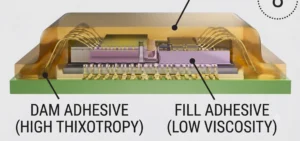
EPO-TEK® H70E-2, 353ND-T, OG198-55