High Electrically & Thermally Conductive Die Attach in Optical Transceiver Modules
At the heart of every optical transceiver is a laser diode or photodetector die bonded to a substrate or carrier. That bond is not just mechanical — it is the primary electrical and thermal pathway between the chip and the package.
In high-speed modules such as QSFP28 (100G), QSFP56 (200G), and QSFP-DD (400G), the die attach adhesive must simultaneously deliver low electrical resistance to support signal integrity and high thermal conductivity to extract heat generated by the chip during operation.
The Dual Challenge of Die Attach in Optoelectronics
EPO-TEK® H20E and its high-conductivity variant H20E-HC are silver-filled epoxy systems developed specifically for this dual requirement — the benchmark conductive die attach adhesives in microelectronics and optoelectronic packaging.
Why Die Attach Conductivity Matters in Transceiver Assembly
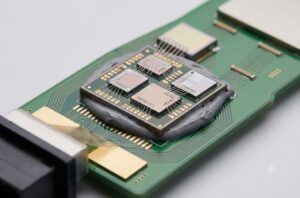
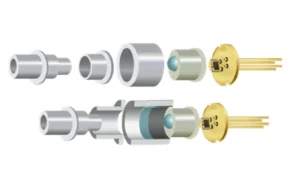
Chip-on-board die attach in TOSA (Transmitter Optical Sub-Assembly) and ROSA (Receiver Optical Sub-Assembly) modules must address two simultaneous challenges that become more demanding with each generation of data rate increase.
EPO-TEK® H20E and H20E-HC address both challenges by combining a fine silver particle network with an epoxy resin matrix that cures into a dense, continuous conductive path — simultaneously solving electrical and thermal requirements in a single bond layer.
EPO-TEK® H20E and H20E-HC — Product Overview
Two grades cover the full range of conductive die attach requirements — from standard optoelectronic bonding to the highest thermal demands of 400G module assembly.
Two-component, silver-filled electrically and thermally conductive epoxy. The industry benchmark for general conductive die attach and chip bonding in microelectronics and optoelectronics.
1:1 mix ratio
2-day pot life
Frozen syringe available
Increased thermal conductivity version of H20E. Achieves 10.9 W/mK at standard cure — rising to 23 W/mK after secondary post-cure at 200°C. Recommended for 400G and above.
≤ 0.00008 Ω·cm
Shore D 93
Frozen syringe available
EPO-TEK® H20E — Technical Specifications
The standard-grade silver-filled conductive die attach epoxy for microelectronic and optoelectronic packaging. Widely used for TOSA/ROSA die attach across QSFP+ (40G) and QSFP28 (100G) platforms.
EPO-TEK® H20E — Full Technical Data
| Property | Value | Note |
|---|---|---|
| Components | Two-part | 1:1 by weight (A:B) |
| Consistency | Smooth thixotropic paste | Shape-retentive after dispense |
| Pot Life | ~2 days @ RT | |
| Recommended Cure | 150°C / 1 hour | |
| Volume Resistivity | ≤ 0.0001 Ohm-cm | Low-resistance ground path |
| Application Method | Dispensing, stamping, screen printing | |
| Single-Component Option | Available as frozen syringe | Pre-mixed, eliminates mix-ratio risk |
| Shelf Life (bulk) | 1 year @ RT | Two-component unmixed |
EPO-TEK® H20E-HC — Technical Specifications
High thermal conductivity variant of H20E. The recommended die attach adhesive for QSFP28 (100G), QSFP56 (200G), and QSFP-DD (400G) where power density demands maximum heat extraction through the bond layer.
EPO-TEK® H20E-HC — Full Technical Data
| Property | Value | Note |
|---|---|---|
| Components | Two-part | 1:1 by weight (A:B) |
| Consistency | Smooth thixotropic paste | |
| Pot Life | 2.5 days @ RT | Slightly longer than H20E |
| Recommended Cure | 150°C / 1 hour | Alt: 175°C / 30 min |
| Thermal Conductivity | 10.9 W/mK → 23 W/mK | After 150°C cure → after 200°C post-cure |
| Volume Resistivity | ≤ 0.00008 Ohm-cm | Better than H20E standard grade |
| Die Shear @ 23°C | ≥ 5 kg (1,778 psi) | Meets microelectronic qualification requirements |
| Shore D Hardness | 93 | Rigid, stable — no creep under thermal cycling |
| Degradation Temp | 372°C | Suitable for reflow-adjacent steps |
| Particle Size | ≤ 45 microns | Fine silver particle network |
| CTE below Tg | 53 × 10⁻⁶ in/in°C | |
| Screen Printing | Compatible | >200 metal mesh, 80D polymer blade |
| Stamping | Compatible | Dots ≥ 6 mil diameter |
| Single-Component Option | Available as frozen syringe | Pre-mixed 1C for automated lines |
| Shelf Life (bulk) | 1 year @ RT |
Post-Cure Advantage: A secondary post-cure at 200°C / 1 hour raises H20E-HC thermal conductivity from 10.9 W/mK to 23 W/mK — more than doubling heat extraction capability. For 400G modules dissipating up to 14W across the full package, this step is strongly recommended.
H20E vs H20E-HC — When to Use Which
Both products share the same silver-filled epoxy chemistry and full process compatibility. The key differentiator is thermal conductivity — driven by your module’s power density requirements.
| Parameter | EPO-TEK® H20E | EPO-TEK® H20E-HC |
|---|---|---|
| Thermal conductivity | Standard | 10.9 W/mK → 23 W/mK (post 200°C) Higher heat |
| Volume resistivity | ≤ 0.0001 Ohm-cm | ≤ 0.00008 Ohm-cm Lower resistance |
| Mix ratio (by weight) | 1:1 | 1:1 |
| Recommended cure | 150°C / 1 hr | 150°C / 1 hr (alt: 175°C / 30 min) |
| Post-cure option | — | 200°C / 1 hr → 23 W/mK Key advantage |
| Die shear | Standard | ≥ 5 kg (1,778 psi) |
| Shore D hardness | Standard | 93 |
| Degradation temp | Standard | 372°C |
| CTE below Tg | Standard | 53 × 10⁻⁶ in/in°C |
| Dispensing / stamping / printing | ✅ Compatible | ✅ Compatible |
| Frozen syringe (1C) | ✅ Available | ✅ Available |
| Primary application | General conductive die attach; chip bonding | High-power die; HB-LED; CPV solar; 400G optoelectronics |
| Best-fit transceiver | QSFP+ (40G), QSFP28 (100G) | QSFP28 (100G), QSFP56 (200G), QSFP-DD (400G) 400G ready |
Die Attach Process in TOSA / ROSA Assembly
The die attach step for a laser diode or photodetector in a TOSA or ROSA sub-assembly follows a structured sequence — precision and cleanliness at each stage directly determine long-term reliability.
① Substrate Prep
Clean Au or Kovar carrier — surface cleanliness directly determines adhesion quality and electrical contact resistance
② Adhesive Dispense
H20E / H20E-HC applied via syringe, stamp, or screen print — volume control critical for bond line thickness
③ Die Placement
Pick & place with optional scrub to improve wetting and eliminate voids under the die
④ Thermal Cure
150°C / 1 hr in box oven, tunnel oven, hot plate, IR, or convection — broad equipment compatibility
⑤ Optional Post-Cure
200°C / 1 hr raises H20E-HC thermal conductivity to 23 W/mK — recommended for 400G high-power modules
⑥ Wire Bond / Alignment
Proceed to active alignment (Step 3 in EPO-TEK® process flow) after bond integrity is confirmed
Single-component frozen syringe: For high-volume TOSA production, the 1C frozen syringe form factor eliminates two-component mixing — reducing preparation time and the risk of mix-ratio errors on automated dispensing lines.
Key Technical Requirements for Die Attach Adhesive in Optoelectronics
Five parameters determine fitness-for-purpose of a conductive die attach adhesive in optical transceiver assembly. H20E-HC is engineered to meet all five simultaneously.
Electrical Conductivity
Volume resistivity ≤ 0.0001 Ω·cm ensures a low-resistance ground return — critical for laser driver and TIA circuits at 25–50 Gbps per lane
Thermal Conductivity
H20E-HC achieves 10.9–23 W/mK depending on cure schedule — reduces die junction temperature and improves laser wavelength stability
Mechanical Strength
Die shear ≥ 5 kg (1,778 psi) meets microelectronic die bond qualification. Shore D 93 — rigid, stable bond that does not creep under thermal cycling
Process Versatility
Compatible with dispensing, stamping, and screen printing. Available as two-component mix or single-component frozen syringe for automated production
Reliability Under Thermal Stress
Degradation temperature 372°C and low weight loss at 200–300°C ensures bond integrity through JEDEC and Telcordia GR-468 thermal cycling qualification
Frequently Asked Questions
EPO-TEK® H20E is the standard-grade silver-filled conductive die attach epoxy. H20E-HC is the high-conductivity variant — same 1:1 two-component silver-filled epoxy system, engineered specifically for higher thermal conductivity. After standard cure at 150°C for 1 hour, H20E-HC achieves 10.9 W/mK. A secondary post-cure at 200°C for 1 hour raises this to 23 W/mK. Both products share full process compatibility including dispensing, stamping, screen printing, and single-component frozen syringe form factor.
EPO-TEK® H20E-HC achieves thermal conductivity of 10.9 W/mK when cured at 150°C for 1 hour. This increases to 23 W/mK when a secondary post-cure at 200°C for 1 hour is applied — more than doubling heat extraction capability. This dual-cure option makes H20E-HC well-suited for high-power devices such as laser diodes in TOSA assemblies, HB-LED packages, and CPV solar chips where maximum heat extraction is critical.
The volume resistivity of EPO-TEK® H20E-HC is ≤ 0.00008 Ohm-cm measured at 23°C after the recommended cure. This ensures a reliable low-resistance ground connection between the die backside and the metal carrier or submount — critical for laser driver and TIA circuits in high-speed optical transceiver modules.
Yes. While H20E-HC is a two-component system (1:1 mix by weight), it is also available as a single-component frozen syringe — pre-mixed and frozen to suppress curing activity at storage conditions. This format is used in automated high-volume TOSA and ROSA die attach lines where eliminating manual mixing reduces preparation time and the risk of mix-ratio variation.
Recommended cure: 150°C / 1 hour. Alternative: 175°C / 30 minutes. For maximum thermal conductivity (23 W/mK), a secondary post-cure at 200°C / 1 hour is recommended after the initial cure. Curing is compatible with box oven, SMT tunnel oven, hot plate, heater gun, IR oven, convection oven, and inductor coil — giving process engineers broad equipment flexibility.
Yes. H20E-HC supports pressure/time dispensing, auger screws, fluid jetting, and G27 needles; screen printing using metal mesh over 200 lines with 80D polymer blade; and stamping to produce dots as small as 6 mil in diameter. The thixotropic paste maintains shape after deposition while allowing controlled flow during dispensing — suitable for high-throughput automated production lines.
EPO-TEK® H20E-HC is recommended for QSFP-DD 400G transceivers operating at 8 lanes × 50 Gbps (PAM4). These modules consume up to 14W for the full package — placing significantly greater thermal demands on the die attach layer. H20E-HC thermal conductivity of up to 23 W/mK post-cure is essential for maintaining safe junction temperatures at this power density.
EPO-TEK® H20E and H20E-HC are recommended for: laser diode and photodetector die attach in TOSA/ROSA/BOSA optical sub-assemblies; HB-LED die attach for light engines in HD-TV and LCD color projection; CPV (concentrator photovoltaic) chip attach onto ceramic carriers; and thermal bonding of ceramic packages to aluminum finned heat sinks. Both products are extensively used in telecom and datacom transceiver manufacturing worldwide.
High-Speed Data Transmission Devices — Full Assembly Guide
This article is part of a structured series covering all six critical bonding steps in QSFP, CFP, and co-packaged optical transceiver assembly.
← Step 1: Low Stress Structural Bonding
EPO-TEK® 320, T7109
← Step 2: Backfill & Optical Structural Bonding
EPO-TEK® 353NDP, H70E-2
← Step 3: Active Alignment
EPO-TEK® HYB-353ND, OG198-54, OG198-55
● Step 4: Conductive Die Attach
EPO-TEK® H20E, H20E-HC — you are here
Step 5: Thermal Management →
EPO-TEK® 930-4, T7109
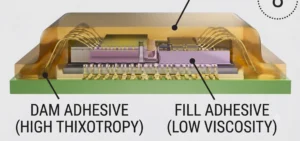
Step 6: Dam & Fill Encapsulation →
EPO-TEK® H70E-2, 353ND-T, OG198-55