Glob Top Dam & Fill Encapsulation for Optical Transceiver Modules
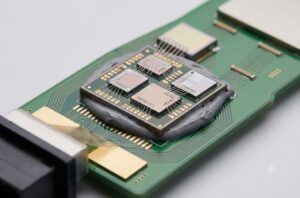
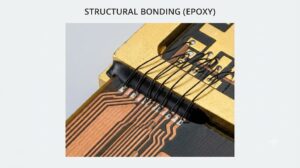
In optical transceiver modules, sensitive semiconductor chips — laser diodes, photodiodes, IC drivers — are connected to the PCB via wire bonding: microscopic gold or aluminum wires that are extremely vulnerable to environmental attack and mechanical shock.
The Two-Step Protection Process
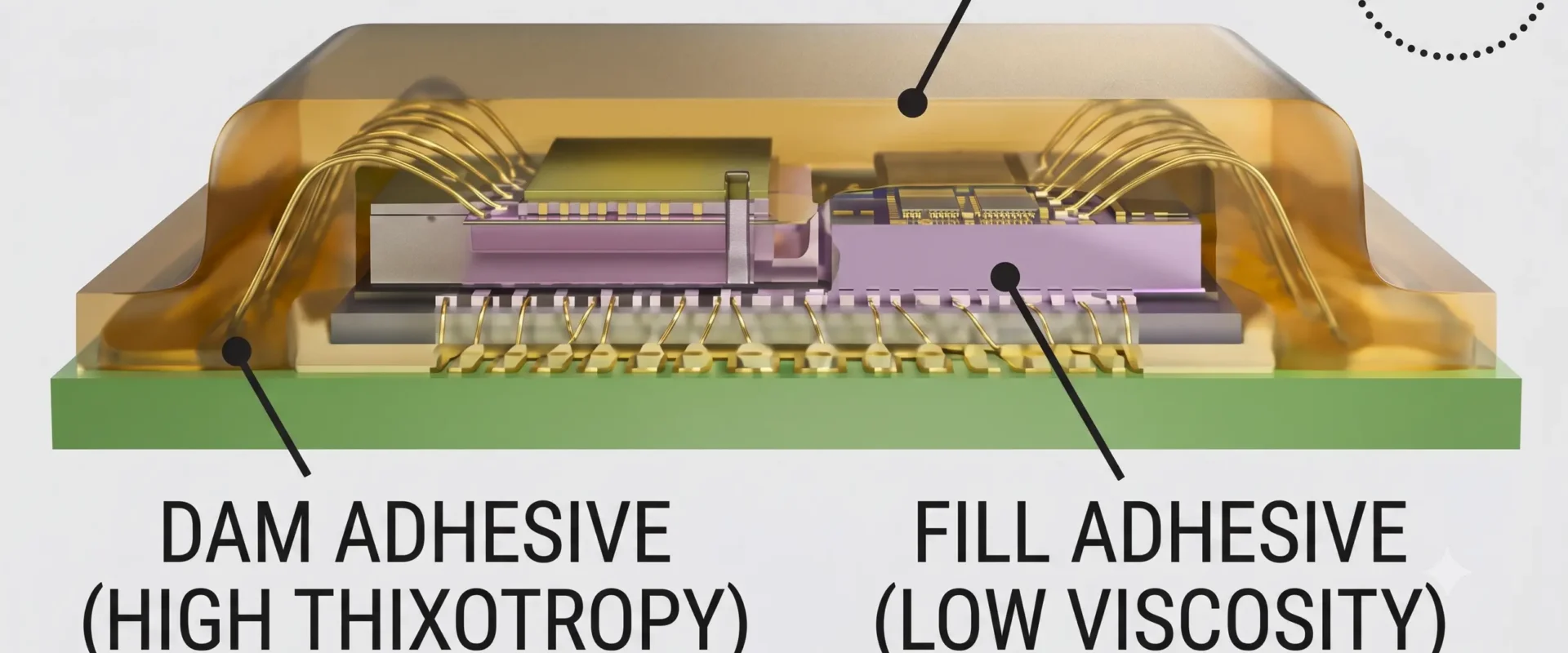
DAM — a high-viscosity, thixotropic material dispensed as a containment wall around the die. FILL — a low-viscosity material poured inside the dam to encapsulate the die and wire bonds completely. Each material serves a distinct role with fundamentally different rheology requirements.
EPO-TEK® provides a complete, purpose-matched product family for every dam-and-fill scenario — thermal cure and UV cure — covering all six critical process requirements:
Moisture Resistance
Block humidity and ionic contamination from reaching bond pads and wire bonds — primary cause of corrosion-related field failures
Vibration Protection
Mechanically stabilize wire bonds against vibration fatigue during shipping and operation
Chemical Resistance
Protect against dust, solvents, and industrial contaminants in field deployment environments
Optical Transparency (Fill)
Fill material must transmit light at operating wavelengths (850, 1310, 1550 nm) without signal attenuation
Shape Retention (Dam)
Dam must hold its dispensed shape — high thixotropic index prevents flow before cure completes
Process Compatibility
Compatible with automated dispensing, syringe needles, and existing thermal or UV cure equipment
EPO-TEK® Dam & Fill Product Overview
Seven products cover every combination of cure method, viscosity, and performance requirement. Select your dam and fill from compatible cure families — or mix thermal dam with UV fill depending on your process constraints.
| Role | Product | Cure | Key Feature |
|---|---|---|---|
| DAM | EPO-TEK® H70E-2 | Thermal | 1.0 W/mK thermal conductivity — also single-dot glob top |
| DAM | EPO-TEK® 353ND-T | Thermal | TI 3.8 non-flowing — Tg ≥90°C, visual cure indicator |
| DAM | EPO-TEK® OG198-55 | UV | TI 6.0 — highest shape retention, shadow cure, Tg ≥120°C |
| FILL | EPO-TEK® 301 | Thermal / RT | ≥99% transmission — lowest viscosity (100–200 cPs), NASA approved |
| FILL | EPO-TEK® 301-2 | Thermal | 8-hour pot life — UV yellowing resistant, NASA approved |
| FILL | EPO-TEK® OG116-31 | UV | No-tail dispensing — Tg ≥115°C, multi-source UV compatible |
| FILL | EPO-TEK® OG198-54 | UV | Shadow cure — 200–450 cPs, paired with OG198-55 dam |
Recommended pairings by process technology:
Full thermal cure: 353ND-T (dam) + 301 or 301-2 (fill) |
Full UV cure: OG198-55 (dam) + OG198-54 (fill) |
Thermal dam + UV fill: H70E-2 (dam) + OG116-31 (fill)
EPO-TEK® Dam Materials — Technical Specifications
Dam materials require high viscosity and high thixotropic index to hold their dispensed shape without flowing — the containment wall must remain intact before and during fill application.
EPO-TEK® H70E-2 — Thermally Conductive Dam / Single-Dot Glob Top
EPO-TEK® H70E-2 — Full Technical Data
| Property | Value | Note |
|---|---|---|
| Components | Two-part | 1:1 by weight (A:B) |
| Viscosity @ 23°C (20 rpm) | 9,000–15,000 cPs | Thixotropic index 1.7 |
| Color (uncured) | Part A: Black / Part B: Cream | |
| Recommended Cure | 150°C / 1 hour | Alt: 80°C/90 min; 120°C/15 min; 175°C/1 min |
| Pot Life | 2 days @ RT | Longest pot life of the three dams |
| Shelf Life | 1 year @ RT (bulk); 1 year @ -40°C (syringe) | |
| Glass Transition (Tg) | ≥ 80°C | |
| CTE below Tg | 20 × 10⁻⁶ in/in°C | Lowest CTE of the three dams |
| Shore D Hardness | 65 | More compliant than 353ND-T |
| Lap Shear @ 23°C | > 2,000 psi | |
| Die Shear @ 23°C | ≥ 5 Kg (1,778 psi) | |
| Operating Temp | < 300°C | Intermittent |
| Thermal Conductivity | 1.0 W/mK | Only dam material with thermal conductivity |
| Volume Resistivity | ≥ 8 × 10¹² Ohm-cm | Electrically insulating |
| Dielectric Constant (1 kHz) | 5.19 |
Unique capability: H70E-2 is the only dam material that also conducts heat (1.0 W/mK). It can be used as a single-dot glob top — one application covers the die directly without a separate fill step — simplifying the process for smaller die sizes or lower-volume production.
EPO-TEK® 353ND-T — Non-Flowing High-Tg Dam Material
EPO-TEK® 353ND-T — Full Technical Data
| Property | Value | Note |
|---|---|---|
| Components | Two-part | 10:1 by weight (A:B) |
| Viscosity @ 23°C (20 rpm) | 9,000–15,000 cPs | |
| Thixotropic Index | 3.8 | Highest among thermal dam materials — true non-flowing |
| Color (uncured → cured) | Tan / Amber → Amber | Color change = visual cure QC indicator |
| Recommended Cure | 150°C / 1 hour | Fast option: 150°C / 1 min |
| Pot Life | 3 hours @ RT | Plan batch size accordingly |
| Shelf Life | 1 year @ RT (bulk); 6 months @ -40°C (syringe) | |
| Glass Transition (Tg) | ≥ 90°C | Highest Tg of thermal dam materials |
| CTE below Tg | 43 × 10⁻⁶ in/in°C | |
| Shore D Hardness | 80 | |
| Lap Shear @ 23°C | 1,953 psi | |
| Die Shear @ 23°C | ≥ 15 Kg (5,334 psi) | 3× higher than H70E-2 |
| Operating Temp | < 325°C | Highest operating temp of dam materials |
| Volume Resistivity | ≥ 4 × 10¹² Ohm-cm |
EPO-TEK® OG198-55 — UV Cure Dam with Shadow Cure & Highest TI
EPO-TEK® OG198-55 — Full Technical Data
| Property | Value | Note |
|---|---|---|
| Components | Single-component | No mixing — no pot life concern |
| Viscosity @ 23°C (100 rpm) | 1,200–2,000 cPs | |
| Thixotropic Index | 6.0 | Highest TI of all seven products — perfect shape retention |
| Color (uncured) | Translucent | |
| Recommended Cure | Iron-doped mercury flood lamp ≥30 sec @ 100 mW/cm² (240–365 nm) | Shadow cure propagates beyond UV zone |
| Thermal Post-Cure | 80°C / 1 hour | Raises die shear from 7,112 to 9,672 psi |
| Shelf Life | 6 months refrigerated | |
| Glass Transition (Tg) | ≥ 120°C | Highest Tg of all seven products |
| CTE below Tg | 72 × 10⁻⁶ in/in°C | |
| Shore D Hardness | 85 | |
| Die Shear (UV only) | ≥ 20 Kg (7,112 psi) | Immediate structural lock |
| Die Shear (UV + 80°C/1hr) | 27.2 Kg (9,672 psi) | Best post-cure strength of all dam materials |
| Spectral Transmission | ≥ 97% @ 560–1,680 nm | Allows optical inspection through cured dam |
| Refractive Index (cured) | 1.5196 @ 589 nm | |
| Particle Size | ≤ 20 microns |
EPO-TEK® Fill Materials — Technical Specifications
Fill materials require low viscosity for capillary wicking into every gap around the die and wire bonds, combined with high optical transparency at operating wavelengths and strong environmental resistance.
EPO-TEK® 301 — Highest Optical Transmission, RT-Cure Fill
EPO-TEK® 301 — Full Technical Data
| Property | Value | Note |
|---|---|---|
| Components | Two-part | Mix ratio 20:5 by weight |
| Viscosity @ 23°C (100 rpm) | 100–200 cPs | Lowest viscosity of all fill materials — water-like wicking |
| Color (uncured) | Clear / Colorless (A & B) | |
| Recommended Cure | 65°C / 2 hours | Also: 23°C / 24 hours (true RT cure) |
| Pot Life | 1–2 hours @ RT | Mix small batches for continuous production |
| Shelf Life | 1 year @ RT | |
| Glass Transition (Tg) | ≥ 65°C | |
| CTE below Tg | 39 × 10⁻⁶ in/in°C | |
| Shore D Hardness | 85 | |
| Lap Shear @ 23°C | > 2,000 psi | |
| Die Shear @ 23°C | ≥ 10 Kg (3,556 psi) | |
| Volume Resistivity | ≥ 1 × 10¹³ Ohm-cm | |
| Spectral Transmission | ≥ 99% @ 382–980 nm; ≥ 97% @ 980–1,640 nm; ≥ 95% @ 1,640–2,040 nm | Broadest transmission window of all fill materials |
| Refractive Index | 1.519 @ 589 nm | |
| NASA Outgassing | NASA Approved | Safe for sealed optical packages |
EPO-TEK® 301-2 — 8-Hour Pot Life, UV-Yellowing Resistant Fill
EPO-TEK® 301-2 — Full Technical Data
| Property | Value | Note |
|---|---|---|
| Components | Two-part | Mix ratio 100:35 by weight |
| Viscosity @ 23°C (100 rpm) | 225–425 cPs | |
| Color (uncured) | Clear / Colorless (A & B) | |
| Recommended Cure | 80°C / 3 hours | Also: 23°C / 48 hours (RT cure) |
| Pot Life | 8 hours @ RT | ~4–8× longer than EPO-TEK® 301 — ideal for large batches |
| Shelf Life | 1 year @ RT (bulk); 6 months @ -40°C (syringe) | |
| Glass Transition (Tg) | ≥ 80°C | Higher Tg than 301 (≥65°C) |
| CTE below Tg | 61 × 10⁻⁶ in/in°C | |
| Shore D Hardness | 80 | Slightly more compliant — better vibration absorption |
| Lap Shear @ 23°C | > 2,000 psi | |
| Die Shear @ 23°C | ≥ 15 Kg (5,334 psi) | Higher than 301 (≥10 Kg) |
| Volume Resistivity | ≥ 2 × 10¹² Ohm-cm | |
| Spectral Transmission | ≥ 94% @ 320 nm; ≥ 99% @ 400–1,200 nm; ≥ 98% @ 1,200–1,600 nm | UV yellowing resistant — stable after 17 days continuous UV |
| Refractive Index | 1.5318 @ 589 nm | |
| NASA Outgassing | NASA Approved |
EPO-TEK® OG116-31 — UV Cure Fill, No-Tail Dispensing, High Tg
EPO-TEK® OG116-31 — Full Technical Data
| Property | Value | Note |
|---|---|---|
| Components | Single-component | No mixing — no pot life |
| Viscosity @ 23°C (10 rpm) | 20,000–30,000 cPs | Thixotropic index 1.3 |
| Color (uncured → cured) | Cloudy White → Clear | Clears on cure — visual indicator |
| Recommended Cure | Iron-doped mercury flood lamp ≥30 sec @ 100 mW/cm² (240–365 nm) | Also: 365nm LED ≥2.5 min; pulsed mercury ≥60 sec |
| Thermal Post-Cure | 80°C / 1 hour | Die shear: 3,556 → 9,636 psi (+171%) |
| Shelf Life | 1 year @ RT | |
| Glass Transition (Tg) | ≥ 115°C | |
| CTE below Tg | 41 × 10⁻⁶ in/in°C | |
| Shore D Hardness | 83 | |
| Die Shear (UV only) | ≥ 10 Kg (3,556 psi) | |
| Die Shear (UV + 80°C/1hr) | 27.1 Kg (9,636 psi) | 171% improvement from post-cure |
| Spectral Transmission | ≥ 96% @ 660–1,640 nm; ≥ 92% @ 500 nm | |
| Refractive Index (cured) | 1.5842 @ 589 nm | |
| Medical-Grade Version | EPO-TEK® MED-OG116-31 | ISO 10993 certified |
No-tail dispensing: OG116-31 rheology is optimized for high-volume syringe needle dispensing — the adhesive cuts cleanly when the needle retracts, leaving no trailing filament. This ensures accurate, repeatable dot placement on automated lines without stringing between dispensed locations.
EPO-TEK® OG198-54 — UV Shadow-Cure Fill, Paired with OG198-55
EPO-TEK® OG198-54 — Full Technical Data
| Property | Value | Note |
|---|---|---|
| Components | Single-component | No mixing — no pot life |
| Viscosity @ 23°C (100 rpm) | 200–450 cPs | Lowest viscosity UV fill — maximum wicking depth |
| Color (uncured) | Clear / Colorless | |
| Recommended Cure | Iron-doped mercury flood lamp ≥30 sec @ 100 mW/cm² (240–365 nm) | Shadow cure propagates into obscured areas |
| Thermal Post-Cure | 80°C / 1 hour | Die shear: 3,556 → 7,894 psi (+122%) |
| Shelf Life | 6 months refrigerated | |
| Glass Transition (Tg) | ≥ 115°C | Same as OG198-55 dam — matched chemistry |
| CTE below Tg | 74 × 10⁻⁶ in/in°C | |
| Shore D Hardness | 86 | |
| Die Shear (UV only) | ≥ 10 Kg (3,556 psi) | |
| Die Shear (UV + 80°C/1hr) | 22.2 Kg (7,894 psi) | |
| Spectral Transmission | ≥ 97% @ 460–1,680 nm | Compatible with 850, 1310, 1550 nm wavelengths |
| Refractive Index (cured) | 1.5256 @ 589 nm |
Dam Materials Comparison: H70E-2 vs 353ND-T vs OG198-55
| Parameter | H70E-2 | 353ND-T | OG198-55 |
|---|---|---|---|
| Cure type | Thermal | Thermal | UV Fastest cure |
| Thixotropic index | 1.7 | 3.8 | 6.0 Best shape hold |
| Glass transition (Tg) | ≥ 80°C | ≥ 90°C | ≥ 120°C Highest |
| Die shear (max) | ≥ 5 Kg | ≥ 15 Kg | 27.2 Kg Strongest |
| CTE below Tg | 20 ppm/°C Lowest | 43 ppm/°C | 72 ppm/°C |
| Pot life | 2 days Longest | 3 hours | N/A (1C) |
| Thermal conductivity | 1.0 W/mK Only dam with TC | — | — |
| Visual cure indicator | — | ✅ Tan → Amber | — |
| Shadow cure | — | — | ✅ UV shadow cure |
| Optical transmission | — | — | ≥ 97% @ 560–1,680 nm |
| Single-dot glob top | ✅ Yes | — | — |
| Best for | Heat dissipation + protection, simple glob top | Max non-flowing, high Tg, thermal QC | UV process, max TI, max Tg, optical inspection |
Fill Materials Comparison: 301 vs 301-2 vs OG116-31 vs OG198-54
| Parameter | EPO-TEK® 301 | EPO-TEK® 301-2 | OG116-31 | OG198-54 |
|---|---|---|---|---|
| Cure type | Thermal / RT | Thermal | UV | UV + shadow |
| Viscosity | 100–200 cPs Lowest | 225–425 cPs | 20,000–30,000 cPs | 200–450 cPs |
| Pot life | 1–2 hrs | 8 hrs Longest | N/A (1C) | N/A (1C) |
| Tg (°C) | ≥ 65 | ≥ 80 | ≥ 115 | ≥ 115 |
| Die shear (max) | ≥ 10 Kg | ≥ 15 Kg | 27.1 Kg UV+cure | 22.2 Kg |
| Peak transmission | ≥ 99% @ 382–980 nm Highest | ≥ 99% @ 400–1,200 nm | ≥ 96% @ 660–1,640 nm | ≥ 97% @ 460–1,680 nm |
| UV yellowing resistance | Standard | ✅ 17 days continuous UV Best | Standard | Standard |
| NASA outgassing | ✅ Approved | ✅ Approved | — | — |
| Shadow cure | — | — | — | ✅ Yes |
| No-tail dispensing | — | — | ✅ Optimized | — |
| Medical grade available | — | — | ✅ MED-OG116-31 | — |
| Best for | Max transmission, RT cure, optical devices | Large batch production, UV-light environments | UV production lines, no pot life constraint | Paired UV system with OG198-55 |
Dam-and-Fill Process Guide
Four sequential steps — each with material-specific requirements. Errors at any stage directly affect final wire bond protection and optical performance.
① Dispense Dam
Apply high-viscosity dam material in a continuous closed loop around the die. Verify no gap in the wall before proceeding — any opening will allow fill to escape
② Pre-Cure Dam
UV dam (OG198-55): flood expose ≥30 sec to lock shape. Thermal dam: light pre-bake to increase viscosity and stabilize the wall before fill
③ Dispense Fill
Apply low-viscosity fill to the center of the dam. Capillary action and gravity pull the fill into all gaps — no pressure needed for 301, 301-2, OG198-54. Inspect for voids
④ Final Cure
Cure both dam and fill to full cross-link density. For UV systems, thermal post-cure (80°C/1hr) is strongly recommended to maximize die shear strength by up to 3×
Important Process Notes
Do not exceed 25 grams per manual mixing batch for two-component thermal systems. Store OG198-54 and OG198-55 at ≤4°C. If EPO-TEK® 301-2 crystallizes during storage, warm gently before use per Tech Tip #7. Syringe packaging may affect initial viscosity — validate dispense parameters before production runs.
Frequently Asked Questions
Dam material requires high viscosity and high thixotropic index to hold its dispensed shape as a containment wall — preventing fill from flowing out. Fill material requires low viscosity for capillary wicking into every gap around the die and wire bonds. EPO-TEK® provides 3 dedicated dam materials and 4 fill materials, each engineered for their specific role in optical transceiver glob top assembly.
OG198-55 is the high-thixotropic-index dam version (TI 6.0, 1,200–2,000 cPs) — it holds its dispensed shape as the containment wall. OG198-54 is the low-viscosity fill version (200–450 cPs) — it wicks into all gaps under and around wire bonds. Both share the same UV shadow-cure chemistry and Tg ≥115°C — a matched pair for full UV dam-and-fill systems.
Both are clear, low-viscosity thermal cure fills with NASA outgassing approval. EPO-TEK® 301 has pot life 1–2 hours and cures at 65°C — preferred when lower cure temperature is needed. EPO-TEK® 301-2 has pot life 8 hours and cures at 80°C, with UV yellowing resistance stable after 17 days continuous UV exposure. 301-2 is preferred for large production batches; 301 for lower cure temperature requirements.
Yes. H70E-2 supports single-dot glob top application — one material applied directly over the die without a separate fill step. This simplifies the process for smaller die sizes or lower-volume production. H70E-2 can also function as dam material in a standard two-step dam-and-fill process.
Yes, with process validation. UV cure (OG198-55 dam + OG198-54 fill, or OG116-31) offers faster cycle time and eliminates oven cure — but requires UV lamp investment. Thermal cure (H70E-2 or 353ND-T dam + 301 or 301-2 fill) has lower equipment cost. Both achieve comparable final bond strength when thermal post-cure is applied to UV systems.
Yes. Thixotropic Index 3.8 and true non-flowing characteristic make 353ND-T an ideal dam material for COB assembly in circuit and fiber optic packaging. It provides visual cure verification (color change tan → amber), die shear ≥ 15 Kg, and Tg ≥ 90°C for high-temperature operating environments.
EPO-TEK® 301 achieves the highest spectral transmission: ≥99% from 382–980 nm and ≥97% from 980–1,640 nm — covering the full datacom (850 nm) and telecom (1310, 1550 nm) range with minimal insertion loss. It also reaches ≥95% from 1,640–2,040 nm — the broadest IR window of all four fill materials.
High-Speed Data Transmission Devices — Full Assembly Guide
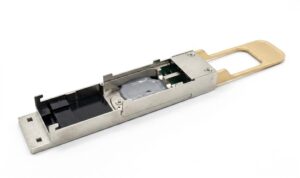
This article covers Step 6 — the final protection layer in QSFP, CFP, and co-packaged optical transceiver assembly.
← Step 1: Low Stress Structural Bonding
EPO-TEK® 320, T7109
← Step 2: Backfill & Optical Structural Bonding
EPO-TEK® 353NDP, H70E-2
← Step 3: Active Alignment
EPO-TEK® HYB-353ND, OG198-54, OG198-55
← Step 4: Conductive Die Attach
EPO-TEK® H20E, H20E-HC
← Step 5: Thermal Management
EPO-TEK® 930-4, T7109
● Step 6: Dam & Fill Encapsulation
EPO-TEK® H70E-2, 353ND-T, OG198-55 / 301, 301-2, OG116-31, OG198-54 — you are here