Thermal Management (Electrically Insulating) in High-Speed Data Transmission Devices
Next-generation high-speed data transceiver modules — from QSFP-DD 400G to coherent transceivers for 5G infrastructure and datacenter applications — operate at increasingly high power densities. Localized heat accumulation at laser chips, photodiodes, and driver ICs is the leading cause of performance degradation and shortened device lifetime.
The Dual Requirement: Conduct Heat, Block Current
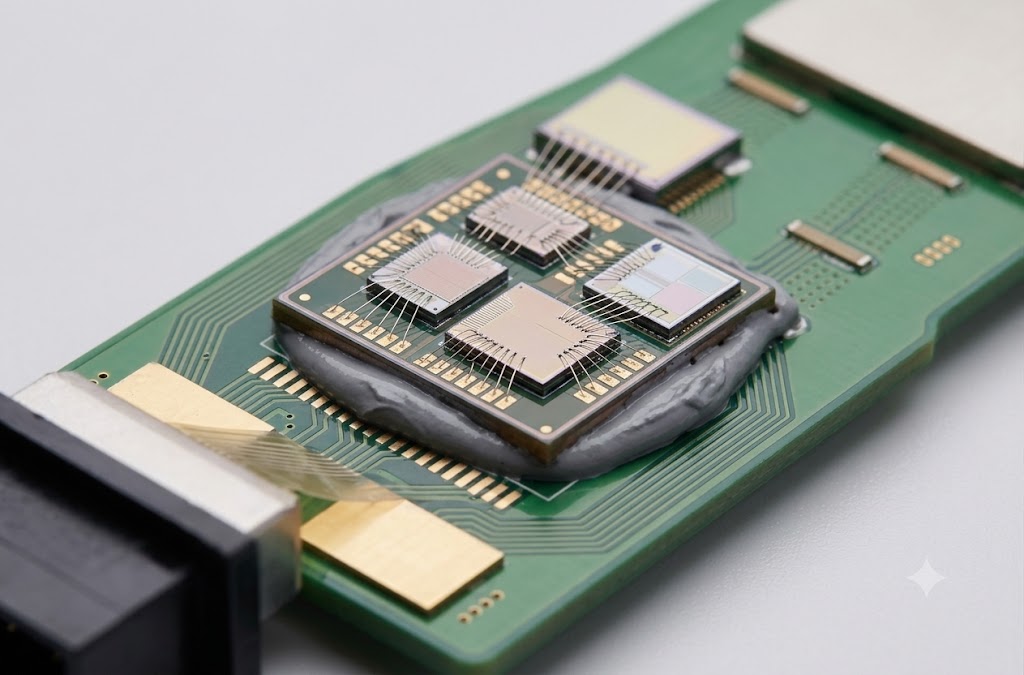
The thermal management adhesive at Position 5 in the EPO-TEK® assembly sequence must simultaneously conduct heat away from the chip and remain completely electrically insulating — protecting the circuit while maintaining thermal stability across thousands of thermal cycles.
EPO-TEK® 930-4 and EPO-TEK® T7109 are engineered precisely for this dual requirement — the benchmark thermally conductive, electrically insulating epoxies for optical transceiver module assembly.
Why Thermal Management Is Critical in Optical Transceivers
The thermal management adhesive layer must satisfy five demanding and simultaneous requirements — each of which becomes more stringent with each generation of data rate increase.
High Thermal Conductivity
Must efficiently transfer heat from chip to heat sink or module housing — inadequate conductivity raises junction temperatures and degrades laser performance
Complete Electrical Insulation
Must not cause current leakage or short circuit between die and substrate — volume resistivity requirements typically exceed 10¹² Ω·cm
Multi-Material Adhesion
Must bond reliably to metals, ceramics, semiconductors, and plastics — typical substrates include Kovar, aluminum, Au, GaAs, and Kapton
Thermal Cycling Stability
Must maintain bond integrity through thousands of thermal cycles — from -40°C to +85°C per Telcordia GR-468 qualification requirements
Process Flexibility
Must be compatible with automated dispensing and screen printing — to fit into high-volume SMT production environments without manual intervention
Recommended EPO-TEK® Products for Thermal Management
Two grades address the full range of thermal management requirements — from standard heat sink bonding to low-stress die attach for large or fragile semiconductor devices.
Two-component, boron-nitride filled, thermally conductive, electrically insulating epoxy. Industry standard for heat sink attach, die attach on JEDEC packages, and hybrid microelectronics. NASA ASTM E595 compliant.
≥ 2×10¹³ Ω·cm
NASA ASTM E595
Visual cure indicator
Two-component, thermally conductive, electrically insulating epoxy with significantly lower modulus than 930-4. EPO-TEK®’s recommended low-stress alternative for large die (>500 mil), TEC cooler attach, and fiber optic packaging.
≥ 8×10¹² Ω·cm
Low modulus
TEC cooler attach
EPO-TEK® 930-4 — Technical Specifications
The industry-standard thermally conductive, electrically insulating epoxy for optical transceiver module assembly. Boron-nitride filler delivers 1.7 W/mK thermal conductivity with Tg ≥ 90°C and NASA outgassing compliance.
EPO-TEK® 930-4 — Full Technical Data
| Property | Value | Note |
|---|---|---|
| Components | Two-part (also 1C frozen syringe) | Mix ratio 100:3.3 by weight |
| Viscosity @ 23°C (20 rpm) | 12,000–17,000 cPs | Thixotropic index 2.4 |
| Color (uncured) | Part A: Ivory / Part B: Amber | Changes to amber at cure — visual QC indicator |
| Recommended Cure | 150°C / 1 hour | Alt: 100°C/4 hr; 80°C/6 hr |
| Pot Life (bulk) | 1 day @ RT | |
| Shelf Life | 1 year @ RT (bulk); 6 months @ -40°C (syringe) | |
| Glass Transition (Tg) | ≥ 90°C | Higher than T7109 (≥45°C) |
| CTE below Tg | 27 × 10⁻⁶ in/in°C | Low — minimizes thermal mismatch |
| Shore D Hardness | 85 | |
| Die Shear @ 23°C | ≥ 15 Kg (5,334 psi) | |
| Lap Shear @ 23°C | 1,927 psi | |
| Operating Temp | < 325°C | Intermittent |
| Thermal Conductivity | 1.7 W/mK | Boron-nitride filler |
| Volume Resistivity | ≥ 2 × 10¹³ Ohm-cm | Excellent electrical insulation |
| Dielectric Constant (1 kHz) | 3.73 | |
| Dissipation Factor (1 kHz) | 0.004 | |
| NASA Outgassing | Passes ASTM E595 | Critical for optical surface protection |
Key Performance Advantages
1.7 W/mK with Full Insulation
Boron-nitride filler achieves 1.7 W/mK thermal conductivity while maintaining ≥ 2×10¹³ Ω·cm resistivity — simultaneously solving both requirements
Visual Cure Indicator
Adhesive changes color from ivory to amber at optimal cure — enables non-destructive visual QC at the production line without additional test equipment
NASA ASTM E595 Compliant
Critical for sealed optical packages — outgassing residues can form contaminating films on optical surfaces and degrade transmission over time
Low-Temperature Cure Option
Can cure at 80°C / 6 hours — compatible with heat-sensitive components or low-cost plastic housings where high-temperature oven cure is not feasible
Primary Applications
Heat Sink Attach on PCB
Bonding heat sinks to module PCB surfaces — primary thermal pathway from component to housing
DIP / TO-Can Packages
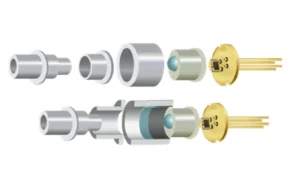
Thermal management in hybrid DIP packages and TO-can optical sub-assemblies
Power Device Die Bonding
Die attach for power devices requiring simultaneous electrical isolation and heat extraction
Flip-Chip Underfill / Glob Top
Thermally conductive underfill and glob top encapsulation for flip-chip die in optical modules
EPO-TEK® T7109 — Technical Specifications
EPO-TEK®’s recommended low-stress alternative to 930-4. Specifically designed for large die attach (>500 mil × 500 mil), TEC cooler bonding, and fiber optic packaging where reduced mechanical stress on fragile components is the primary design constraint.
EPO-TEK® T7109 — Full Technical Data
| Property | Value | Note |
|---|---|---|
| Components | Two-part | Mix ratio 10:1 by weight |
| Viscosity @ 23°C (20 rpm) | 14,000–20,000 cPs | Thixotropic index 1.8 |
| Color (uncured) | Part A: White / Part B: Amber | |
| Recommended Cure | 150°C / 1 hour | Alt: 100°C/4 hr; 80°C/8 hr |
| Pot Life (bulk) | 4 hours @ RT | Shorter than 930-4 — plan dispense accordingly |
| Shelf Life | 1 year @ RT | |
| Glass Transition (Tg) | ≥ 45°C | Lower Tg — softer at elevated temps (reduced stress) |
| CTE below Tg | 46 × 10⁻⁶ in/in°C | |
| Shore D Hardness | 83 | Slightly softer than 930-4 (85) |
| Die Shear @ 23°C | ≥ 15 Kg (5,334 psi) | Same strength as 930-4 |
| Lap Shear @ 23°C | > 2,000 psi | |
| Operating Temp | < 300°C | Intermittent |
| Thermal Conductivity | 0.7 W/mK (40 mil BLT) / 1.5 W/mK (3 mil BLT) | Bond line thickness dependent |
| Storage Modulus | 258,593 psi | ~2.3× lower than 930-4 (607,651 psi) — key low-stress advantage |
| Volume Resistivity | ≥ 8 × 10¹² Ohm-cm | Excellent electrical insulation |
| Dielectric Constant (1 kHz) | 3.50 | |
| Dissipation Factor (1 kHz) | 0.004 |
Bond Line Thickness Optimization: T7109 thermal conductivity is bond line dependent — 1.5 W/mK at 3 mil bond line, compared to 0.7 W/mK at 40 mil. Engineers can optimize thermal performance by controlling bond line thickness during the dispense and placement steps. EPO-TEK® Technical Paper #42 contains full thermal resistance data across bond line thicknesses.
Primary Applications in Fiber Optic & Photonic Packaging
TEC Cooler Attach
Directly recommended by EPO-TEK® for Thermoelectric Cooler bonding in fiber optic packaging — good adhesion to Au, Kovar, and ceramic substrates
Large Die Attach (>500 mil)
Lower modulus (258,593 psi) reduces crack and delamination risk on large die and thin GaAs devices that cannot tolerate high stress bonding
Optical Bench Substrate Attach
Bonding optical bench elements to the module housing in photonic packaging — stress-sensitive optical alignment requires compliant adhesive
Ceramic Substrate to Housing
Attaching ceramic substrates and hybrid circuits to metal housings in fiber optic transceivers — strong adhesion to Kapton, aluminum, and ferrous metals
EPO-TEK® 930-4 vs T7109 — Complete Comparison
Both products are thermally conductive and electrically insulating — the key differentiator is mechanical modulus. Choose 930-4 for maximum thermal performance and high Tg; choose T7109 when low mechanical stress on the die is the priority.
| Parameter | EPO-TEK® 930-4 | EPO-TEK® T7109 |
|---|---|---|
| Thermal conductivity | 1.7 W/mK Higher | 0.7–1.5 W/mK (bond line dependent) |
| Volume resistivity | ≥ 2 × 10¹³ Ohm-cm Higher insulation | ≥ 8 × 10¹² Ohm-cm |
| Storage modulus | 607,651 psi (stiffer) | 258,593 psi Lower stress |
| Glass transition (Tg) | ≥ 90°C Higher | ≥ 45°C |
| CTE below Tg | 27 ppm/°C Lower | 46 ppm/°C |
| Die shear @ 23°C | ≥ 15 Kg (5,334 psi) | ≥ 15 Kg (5,334 psi) |
| Pot life | 1 day | 4 hours |
| Mix ratio (by weight) | 100 : 3.3 | 10 : 1 |
| Filler type | Boron-nitride | Not disclosed |
| Visual cure indicator | ✅ Ivory → Amber QC advantage | — |
| NASA ASTM E595 | ✅ Passes HI-REL | Not specified |
| TEC Cooler attach | — | ✅ Directly recommended Fiber optic |
| Large die (>500 mil) | — | ✅ Recommended Low stress |
| Best-fit application | Max thermal performance, Tg ≥ 90°C, visual QC, NASA outgassing | Large die, TEC cooler, fiber optic packaging, GaAs devices |
Application & Process Guidelines
Both 930-4 and T7109 follow the same general application workflow. Key differences are in mix ratio and pot life — plan your production batch size accordingly.
Preparation & Mixing
Stir Before Mixing
Thoroughly stir each component separately before combining — especially critical for filled systems where filler can settle
Accurate Mix Ratio
930-4: 100:3.3 by weight. T7109: 10:1 by weight. Off-ratio mixing directly impacts thermal conductivity and cure completeness
Keep Container Sealed
Keep containers tightly sealed when not in use to prevent moisture contamination — moisture absorption degrades both adhesion and electrical insulation
Batch Size Limit
Do not exceed 25 grams per manual mixing batch — larger volumes generate exothermic heat that can prematurely advance cure and reduce pot life
Dispensing Methods
Both 930-4 and T7109 are compatible with: automatic dispensing (Nordson, Asymtek), screen / stencil printing, pin transfer, and spatula / manual application. Syringe packaging may affect initial viscosity and pot life — validate dispense parameters with syringe format before production runs.
Cure Schedules
Cure Schedule Options — 930-4 & T7109
| Schedule | Temperature / Time | Note |
|---|---|---|
| Recommended | 150°C / 1 hour | Achieves all listed performance properties |
| Fast cure | 150°C / 10 minutes | May not achieve full performance — verify for your application |
| Medium temp | 100°C / 4 hours | Suitable for moderately heat-sensitive assemblies |
| Low temp | 80°C / 6–8 hours | For heat-sensitive components or plastic housings |
Frequently Asked Questions
No. EPO-TEK® 930-4 is thermally conductive but completely electrically insulating, with volume resistivity ≥ 2×10¹³ Ohm-cm. It is safe for direct contact with live circuits and is specifically designed for applications where heat must be dissipated without creating electrical pathways between components.
EPO-TEK® T7109 is directly recommended for TEC (Thermoelectric Cooler) attach in fiber optic packaging. It provides strong adhesion to Au, Kovar, and ceramic substrates, and its low storage modulus (258,593 psi) reduces mechanical stress on the cooler — preventing delamination caused by differential thermal expansion during operation.
T7109 is EPO-TEK®’s officially positioned low-stress alternative to 930-4 — preferred for large die (>500 mil) and fiber optic packaging. However, 930-4 delivers higher Tg (≥90°C vs ≥45°C), higher thermal conductivity at thick bond lines (1.7 W/mK vs 0.7 W/mK at 40 mil), and NASA ASTM E595 outgassing compliance. Choose based on which properties your specific application requires.
Yes. EPO-TEK® 930-4 passes the NASA low outgassing standard ASTM E595 when properly cured at 150°C for 1 hour. This is critical for sealed optical packages — outgassing residues can condense on optical surfaces and degrade transmission performance over time.
EPO-TEK® recommends both 930-4 and T7109 for Position 5 (Thermal Management, Electrically Insulating) in High-Speed Data Transmission Devices including QSFP, SFP+, and CFP transceiver modules. 930-4 is the standard grade for maximum thermal performance; T7109 is the low-stress variant for large die and TEC cooler applications.
Yes. T7109 is designed for large die attach, ceramic substrate-to-housing bonding, and applications requiring excellent adhesion to GaAs devices. It also adheres well to Kapton, aluminum, and ferrous and non-ferrous metals — covering the primary substrate materials found in compact optical module assemblies.
EPO-TEK® T7109 thermal conductivity is bond line thickness dependent: 0.7 W/mK at a 40 mil bond line, and 1.5 W/mK at a 3 mil bond line. Engineers can optimize thermal performance by controlling dispensed volume and placement pressure to achieve a thinner bond line. Full thermal resistance data across bond line thicknesses is available in EPO-TEK® Technical Paper #42.
High-Speed Data Transmission Devices — Full Assembly Guide
This article is part of a structured series covering all six critical bonding steps in QSFP, CFP, and co-packaged optical transceiver assembly.
← Step 1: Low Stress Structural Bonding
EPO-TEK® 320, T7109
← Step 2: Backfill & Optical Structural Bonding
EPO-TEK® 353NDP, H70E-2
← Step 3: Active Alignment
EPO-TEK® HYB-353ND, OG198-54, OG198-55
← Step 4: Conductive Die Attach
EPO-TEK® H20E, H20E-HC
● Step 5: Thermal Management
EPO-TEK® 930-4, T7109 — you are here
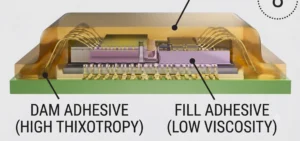
Step 6: Dam & Fill Encapsulation →
EPO-TEK® H70E-2, 353ND-T, OG198-55