Why Adhesive Selection Is Critical in Optical Modules
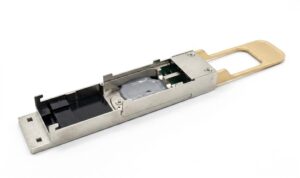
High-speed optical transceiver modules — QSFP, CFP, SFP+ — are among the most demanding environments for adhesive materials. Tiny form factors, precision-aligned optics, and extreme thermal cycling mean that a wrong adhesive choice can destroy module yield and shorten device lifespan.
The Core Engineering Tension
The adhesive must be firm enough to hold components securely through vibration and thermal cycling — yet soft enough not to stress precision-aligned optical components by even a single micron.
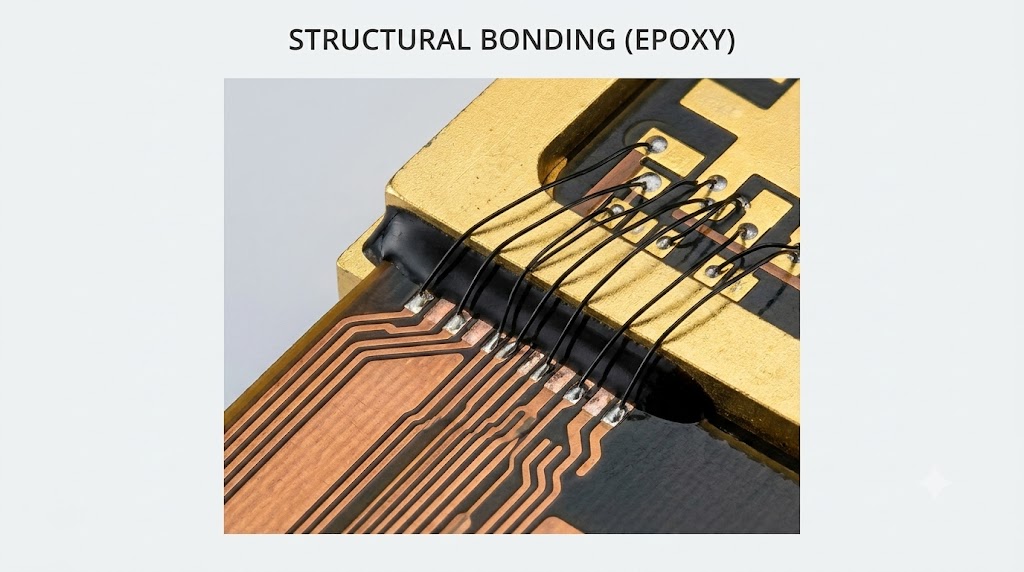
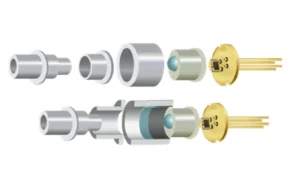
At Position 1 in the Epotek application map — the structural bonding of ferrule, connector interface, housing, and fiber feed-through — five competing requirements must be satisfied simultaneously:
Mechanical Strength
Secure assembly through vibration, thermal cycling, and mechanical handling stress
Optical Opacity
Block stray light across 300–2,500 nm to prevent signal crosstalk and detector noise
Low Mechanical Stress
Prevent micron-level misalignment of optical fibers, lenses, and waveguides
Thermal Stability
Withstand operating heat from high-speed laser drivers and limiting amplifiers
Material Compatibility
Adhere to metals (Kovar, aluminum), ceramics, plastics, and glass substrates
Concept
What Is Low-Stress Structural Bonding?
Every adhesive generates internal stress when it cures and when temperature changes occur, due to CTE (Coefficient of Thermal Expansion) mismatch between bonded materials. In optical packaging, this stress is a critical failure mode.
μm-level
Fiber misalignment that causes measurable insertion loss
↑IL
Insertion loss from birefringence in polarization-sensitive elements
↓MTBF
Delamination over time — reducing long-term device reliability
Definition: Low-stress structural bonding uses an adhesive with a lower elastic (storage) modulus, allowing it to flex and absorb differential thermal expansion — rather than transmitting rigid stress forces to adjacent sensitive optical or electronic components.
The Solutions
Meet the Two Products
Epoxy Technology (EPO-TEK®) addresses the Position 1 bonding challenge with two complementary products. Understanding when to use each is the key to reliable module assembly.
Standard
EPO-TEK® 320
Two-component, optically opaque black epoxy for structural bonding where light-blocking and low stress are both required. Room-temperature cure capable.
One of the most widely used adhesives for ferrule potting, fiber sealing, and package wall feed-throughs worldwide
Product Detail
EPO-TEK® T7109 — Technical Specifications
Selected when the bonding position is subject to significant heat generation — 100G/400G/800G modules where active component heat must be dissipated through the bond joint.
EPO-TEK® T7109 — Full Technical Data
Property
Value
Note
Product Type
Two-component epoxy
Thermally conductive
Mix Ratio (by weight)
10 : 1 (A : B)
Part A white / Part B amber
Recommended Cure
150°C / 1 hour
Or 80°C/8 hrs, 100°C/4 hrs
Viscosity @ 23°C
14,000 – 20,000 cPs
Smooth paste
Pot Life
4 hours @ RT
Longer workability window
Glass Transition (Tg)
≥ 45°C
Storage Modulus
258,593 psi
~2× lower than EPO-TEK® 320
Lap Shear Strength
> 2,000 psi @ 23°C
Die Shear Strength
≥ 15 Kg (5,334 psi)
@ 23°C
Thermal Conductivity
0.7–1.5 W/mK
40 mil BLT / 3 mil BLT respectively
Volume Resistivity
≥ 8 × 10¹² Ohm-cm
Excellent electrical insulation
Operating Temp
< 300°C
Intermittent
Lower Modulus = Less Stress: T7109’s storage modulus of 258,593 psi is roughly half that of EPO-TEK® 320 (506,751 psi). For large bonded areas, thermally mismatched substrates, or substrates over 500 mil × 500 mil, this compliance difference is significant — it directly reduces the risk of stress-induced optical misalignment and component cracking.
Side by Side
Complete Comparison: EPO-TEK® 320 vs T7109
Property
EPO-TEK® 320
EPO-TEK® T7109
Components
Two
Two
Mix Ratio (wt)
10 : 2
10 : 1
Recommended Cure
65°C / 2 hrs
150°C / 1 hr
Min. Alternative Cure
23°C / 24 hrs ✅
80°C / 8 hrs
Viscosity @ 23°C
700–1,200 cPs
14,000–20,000 cPs
Pot Life
1 hour
4 hours
Tg
≥ 55°C
≥ 45°C
Storage Modulus
506,751 psi
258,593 psi Lower stress
Lap Shear
> 2,000 psi
> 2,000 psi
Die Shear
≥ 15 Kg
≥ 15 Kg
Thermal Conductivity
N/A
0.7–1.5 W/mK Active heat
Volume Resistivity
≥ 1 × 10⁶ Ω·cm
≥ 8 × 10¹² Ω·cm Better isolation
Optical Opacity
<1% @ 300–2,500 nm Light blocking
Not specified
Color (cured)
Black
White/Amber
Primary Use Case
Fiber optic bonding, ferrule sealing
Thermally critical die/substrate attach
Selection Guide
Which Product Should You Choose?
The decision comes down to one key question: does the bond position generate significant heat? Use this guide to select the right product for your application.
Use EPO-TEK® 320 when:
No active thermal dissipation is required at the bond joint
Optical opacity / light-blocking is needed at the bonding site
Low-temperature or room-temperature curing is required
Fiber potting, ferrule sealing, or light-isolating structural joints
Automated syringe dispensing or low-viscosity application required
Use EPO-TEK® T7109 when:
Bond region is subject to heat from active optical or electronic components
Both thermal conductivity AND low mechanical stress are required
Substrates are large (>500 mil) or have significant CTE mismatch
Maximum electrical isolation (≥ 8 × 10¹² Ω·cm) is needed
Optical bench, TEC cooler, or large substrate attach in fiber optic packaging
Industry Context
Why This Matters in 2025 and Beyond
The global demand for high-speed optical transceivers is accelerating — driven by hyperscale data center expansion, 5G infrastructure rollout, and AI inference workloads. As data rates push from 400G to 800G and beyond, the thermal and optical demands on adhesive materials become significantly more stringent.
Adhesive Selection Is a Photonic Engineering Decision
A poor adhesive choice reduces module yield, shortens device lifespan, and increases field failure rates. EPO-TEK® 320 and T7109 have been specifically developed and validated for optical packaging environments — backed by Epoxy Technology’s decades of experience in photonics and semiconductor manufacturing.
Higher alignment stability over the full device lifetime
Reduced thermal degradation of optical insertion loss performance
Lower risk of adhesive-induced component cracking or fiber misalignment
Compliance with fiber optic industry reliability standards (Telcordia, IEC)
Simplified manufacturing with well-characterized, proven materials
FAQ
Frequently Asked Questions
Can EPO-TEK® 320 be cured at room temperature?
Yes. EPO-TEK® 320 cures at 23°C for 24 hours — making it suitable for temperature-sensitive assemblies or modules where oven curing isn't feasible. The recommended accelerated cure is 65°C for 2 hours for faster throughput.
Why does T7109 have a lower storage modulus than EPO-TEK® 320?
T7109's more compliant polymer matrix (258,593 psi vs 506,751 psi) is designed to absorb differential thermal expansion from large die substrates (>500 mil × 500 mil) and thermally mismatched components — rather than transmitting stress rigidly to sensitive optical elements nearby.
Does EPO-TEK® T7109 block light like EPO-TEK® 320?
No. EPO-TEK® 320 is specifically formulated for optical opacity (<1% transmission, 300–2,500 nm). T7109 is selected for thermal conductivity and low modulus — not light blocking. If both properties are simultaneously required, contact our technical team for application-specific guidance.
Which product is the industry standard for ferrule and fiber potting?
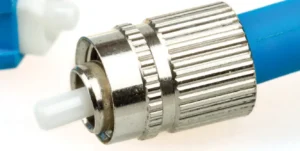
EPO-TEK® 320 is the industry-standard choice for ferrule sealing and fiber potting. Its low viscosity (700–1,200 cPs) enables precise dispensing into tight spaces, while its complete optical opacity prevents stray light from entering the optical package at the fiber entry point.
What substrates does EPO-TEK® T7109 adhere to?
T7109 provides excellent adhesion to gold (Au), Kovar, ceramic, aluminum, GaAs, and most plastics including Kapton — covering the primary substrate materials found in high-speed optical transceiver assemblies.
Our technical team specializes in adhesive selection for electronics, photonics, and telecom manufacturing in Southeast Asia. Get a fast, application-specific recommendation.